
This blog is written by Aditya Ramnath from Climate Collective Foundation.
At the end of October, my colleagues Kaustub, Nanaji and I spent two days in Bangalore at the kickoff of Project Tech4Dev’s AI Cohort 3.0. This is the first edition of the cohort with a climate focus. Five organizations each bring one problem they want to solve with AI, and work on it over the coming months with a mentor, Tech4Dev’s forward deployed engineers and credits from LLM providers.
We came with one question: How can AI match climate-tech stakeholders with the right opportunities, and nudge them toward their next step before they even ask?
That question comes straight out of our work at Climate Collective Foundation. Since 2016 we have supported 1,749 climate startups, accelerated 1,360 of them across 106 cohorts, and brought 643 investors into our network. 130 of our accelerator alumni have gone on to raise around USD 684 million after graduating. Through all of it, we have seen the same thing again and again. Good ideas stall, not because they are weak, but because the right funder, partner or opportunity arrives too late. Our best program managers solve this by hand: they know a founder well, spot what they need next and make the right introduction. It works, but only for a few founders at a time.
Mosambi, our platform for the climate-tech community, is how we want to reach everyone. Our Events module has been live since September 2026, and our grants module launch at COP31 this month. The AI layer we brought to the cohort is the Cofounder Bot: One assistant that knows a member’s profile and activity across Mosambi and CCF programs, matches them with funding, mentors and events, and nudges them toward their next step.
Designing AI around people
The session I keep coming back to is the design thinking workshop. Arun Thangaraj from Microsoft ran a 90-minute session called Designing AI Around People, and it changed how we talk about the Cofounder Bot.
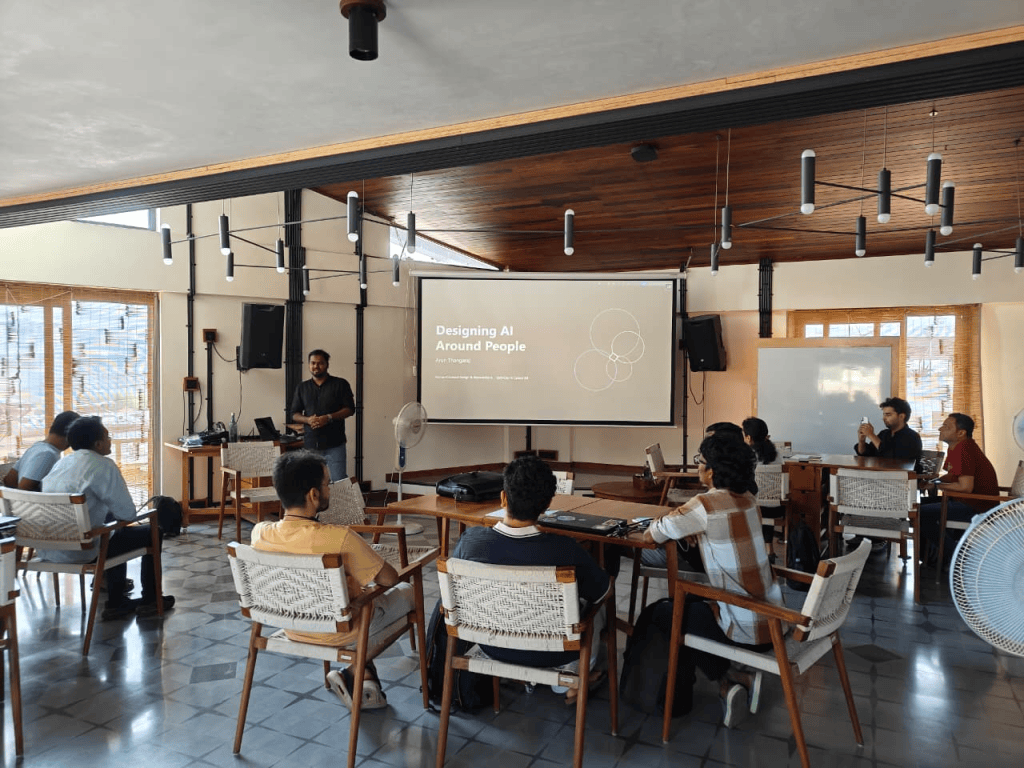
Arun Thangaraj from Microsoft opens the Designing AI Around People workshop.
It is easy to arrive at an AI program thinking about models, prompts and data. Arun made every team start somewhere else: Who the users are, what their day looks like and where the new tool must fit. We built personas and mapped user journeys on a shared Mural board and we looked at each solution from the other side of the screen.
For us, that meant asking very concrete questions:
• Who is the founder who most needs a nudge? Probably not the one already in five programs, but the first-time founder who does not know what to ask for.
• Where will they see it? Founders live on WhatsApp and email, not on a dashboard they open once a week. That is why Mosambi already sends updates on both.
• What makes a nudge welcome rather than noise? It must be timely, specific and clearly in their interest. Someone who has just applied to Climate Pitch might be nudged toward impact reporting, because the investors on the platform ask for it.
• Who checks the bot? Our program managers. Their judgement on whether a match was right is the test the bot must pass.
Tech4Dev’s own lesson from earlier cohorts is that building the tool is the easier part; getting people to use it and keep coming back is the hard part. The workshop gave us a way to design for that from day one.
Mapping the journey with our mentor
Every organization in the cohort is paired with a mentor, and our one-on-one time with Kartikeya was some of the most valuable of the two days. We arrived with a big vision: a Cofounder Bot for every member of Mosambi. We left with a plan that can show real results by the end of our cohort engagement in February 2027.
Kartikeya helped us do three things.
Start narrow. Instead of trying to match everyone to everything, we will begin with two pilots where we already have users and data:
• Capital: Grant matching that goes live with Mosambi’s Fundraising module at COP31, and flags related needs such as impact reporting.
• Events: Surfacing the right sessions and people to meet, building on our first event pilot in Bangalore and testing at Delhi Climate Innovation Week in February.
Get the data right first. The bot is only as good as the profiles and activity behind it. Part of our plan is a secure, anonymized data foundation that Mosambi can reuse well beyond the cohort.
Decide how we will know it works. From December, we will check whether each match and nudge was right using what people did next: viewed, applied, attended, connected. Our program managers will review the results and keep the final say.
Put together, that gives us a path to February:
1. November: Prototype grant matching alongside the Fundraising launch at COP31.
2. December: Start evaluating matches and nudges with our program managers.
3. January: Improve accuracy based on that feedback and strengthen the data foundation.
4. February: Test event matchmaking at Delhi Climate Innovation Week and share what we learned with the cohort.
Having someone outside the team ask “what will you have in February, and how will you prove it?” was exactly the discipline we needed.
Learning from our peers
Tech4Dev grouped this cohort by sector so that organizations could learn from each other, and it worked. Hearing four other climate organizations describe their problems made our own sharper, and it showed us how much we have in common.
• SwitchON Foundation is using AI to screen applications and report status across its programs. That is the same pain we hear from accelerators and incubators every day, and it maps closely to the ESO module we start building on Mosambi in January. We hope to compare notes on scoring criteria and human review.
• Samyak Collective is combining weather, health and geospatial data to help urban health centers prepare for climate-related health risks, with doctors validating every advisory.
• CSTEP is using open geospatial data to estimate rooftop solar potential, starting in a pilot ward.
• CommonsTech Foundation is building a multilingual assistant for its CoRE Stack platform, so that community stewards can understand landscape data and use it in village planning.
The same principles came up in every presentation: Keep answers grounded in verified data, keep a human in the loop for decisions that matter and design for the people who will actually use the tool.
There is also a longer-term opportunity. Every one of these organizations needs what Mosambi is built to provide: Grants and funders that fit their work, partners for pilots and a community that wants to use what they build. CSTEP’s solar assessments could be useful to the solar startups in our network, and Samyak’s work sits squarely in the climate-and-health space that funders increasingly want to back. As Mosambi grows, we would love for our cohort peers to be among the organizations it serves.
A story worth hearing
One of the highlights for the whole room was a talk by Pratap Raju, CCF’s founder. Pratap shared the story of his own journey through the clean-tech world and what led him and a group of fellow clean tech entrepreneurs to start Climate Collective Foundation in 2016.
It was not a talk about AI and that was the point. In a room full of people working on prototypes and pilots, hearing an industry stalwart reflect on what it takes to stay with a hard problem for years was a reminder of why this work matters. You could feel how much it resonated with the audience. For those of us who work with Pratap every day, it was a proud moment.
What comes next
We left Bangalore with a clearer problem, a narrower first step and a plan to February. Over the next few months, we will prototype grant and event matching, evaluate every recommendation with our program managers, and build the data foundation the Cofounder Bot will grow on. We will share what we learn, including what does not work.
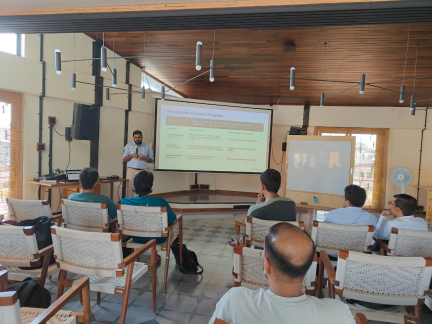
Presenting Mosambi’s Cofounder Bot to the cohort: AI matchmaking, an AI nudger and the data foundation underneath.
Thank you to Project Tech4Dev for bringing this cohort together, to Kartikeya for his time and sharp questions, to Arun for a workshop we will keep using, and to our fellow cohort members for their openness. We are glad to be building alongside you.
Aditya Ramnath leads Mosambi, Climate Collective Foundation’s platform for the climate-tech community.

