
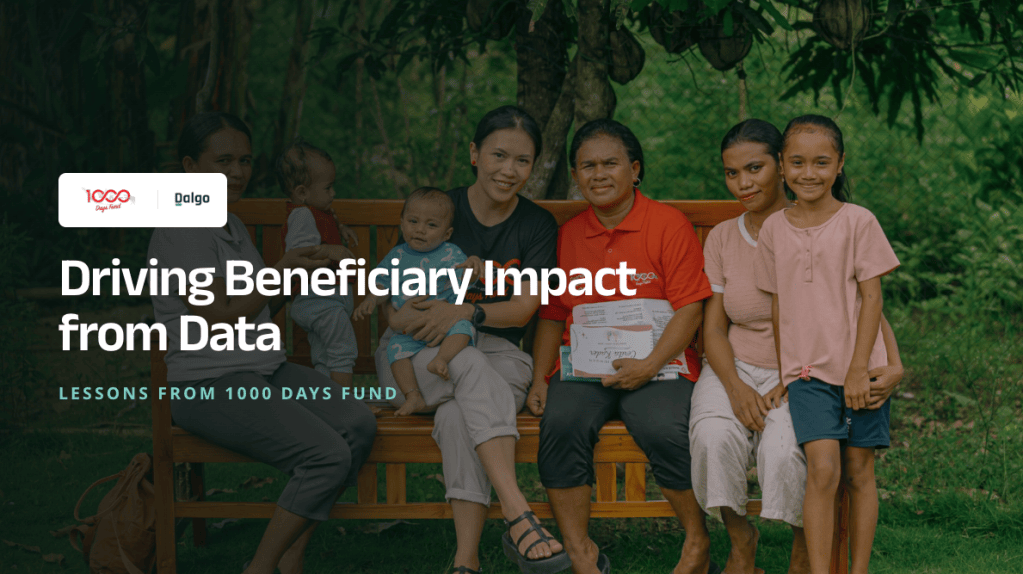
1000 Days Fund works to end stunting in Indonesia by strengthening village health systems. Over seven months, the organisation rebuilt the data foundations underneath that work.
Why Data Matters
“We have a responsibility to ensure data is accurate, timely, and useful for decision-making. Most importantly, data should create a feedback loop: helping us identify problems, adapt programs, and support frontline workers.” — Pandu Gusti Resworo, Data Specialist, 1000 Days Fund
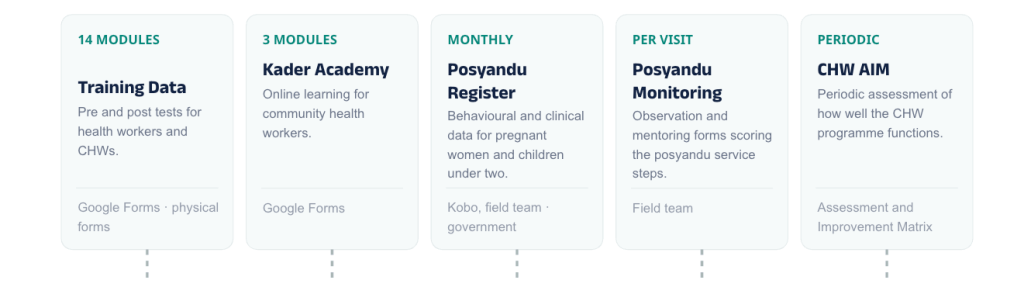
1000 Days Fund (TDF) is a women-led Indonesian nonprofit strengthening village health systems through tiered training, mentoring for health workers and Posyandu community health workers (CHWs), and advocacy for joint financing with local governments. It has reached 1,107,180 pregnant women and children under five and trained 100,534 health workers and CHWs. The model’s sustainability rests on government ownership. Across 102 villages in seven districts of East Nusa Tenggara, local governments now finance the work from their own annual budgets. In Manggarai Barat, child malnutrition fell from 57% to 31% over five years, and maternal malnutrition fell 39% in a single year. Evidence of that kind is what persuades a government to fund the work itself. However, the reporting behind it rested on five systems that could not be read together.
The Problem
- No shared identifier. The same community health worker appeared across trainings under different name spellings, phone numbers and role titles. Counting unique individuals became an analysis task in itself. A training report could give the mean score for a region. It could not say how many people completed both tests, or whether a CHW who scored poorly had improved.
- Form version drift and free-text fields. Different instruments asked for the same variable in different language, so comparison across programmes was not possible.
- No systematic quality checking. Implausible measurements and duplicate records passed through to the report, surfacing after figures had gone out.
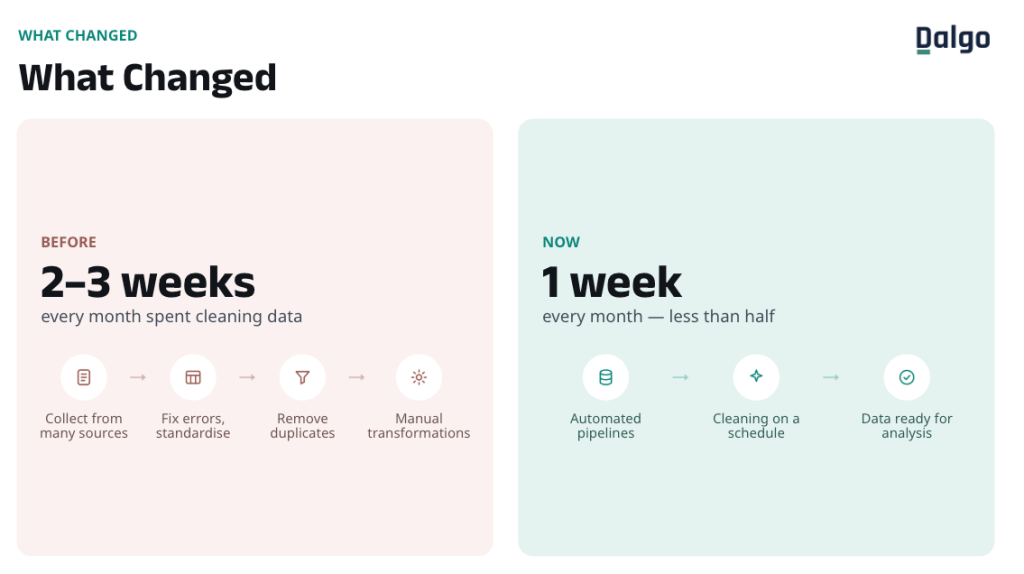
- Spreadsheets at their limit. Broken IMPORTRANGE, no version control, no tests. Consolidation ran through Google Sheets and Colab, resting almost entirely on one specialist in the monitoring, evaluation and research (MER) team. Data preparation consumed two to three weeks of every month.
“The trigger was simply that spreadsheets had stopped being viable — we were spending more effort keeping the system alive rather than using the data.” — Pandu Gusti Resworo
What Changed

TDF assessed Dalgo against three criteria: fluency in community health and M&E data specifically, an open standard stack the team could eventually maintain itself, and nonprofit pricing. Nothing would be locked to a vendor, and consulting support came alongside the platform. All five sources now land on an automated schedule in a warehouse TDF owns and operates. Identity matching pairs pre- and post-test submissions from the same individual, a role dictionary resolves hundreds of free-text variants into three categories, and geography resolves through reference tables. Quality checks run inside the pipeline.
“We can now see how many individuals are actually going through training, matching their scores. We can also see which person only takes the pre and post tests. Previously we only averaged the score in a region.” — Pandu Gusti Resworo
| Team | What Changed |
|---|---|
| MER team | SQL and dbt in a single warehouse; time released from cleaning to analysis not previously possible |
| Programme teams | One source in place of separate spreadsheets; work shifted to interpretation |
| Leadership | One dashboard holding system change and implementation outcomes together; one set of indicator definitions across programmes and donors |
| Field teams and CHWs | Submissions returned as case lists, monitoring scores and data quality feedback |
Data preparation fell from two to three weeks to approximately one week per month. TDF reached warehouse-grade infrastructure without recruiting a data engineer, so an organisation of this size runs that infrastructure on the team it already has. At target level, pregnant women identified with chronic malnutrition or hypertension, and children identified with stunting or weight faltering, are reached sooner for follow-up. Measurement feedback now returns to the CHWs who took the measurement.
“They receive quicker updates and insights from our team. This also helps increase their engagement within the programme as they feel that the feedback loop for their work becomes quicker and more responsive.” — Pandu Gusti Resworo
What It Makes Possible
The ambition is not yet met. Quality-control checks and automated alerts remain to be built, and automation does not determine what a flagged measurement means; that judgement stays with the team.
“In the future, we are able to substantiate our findings, and defend them with the data foundations.” — Pandu Gusti Resworo
That is the point of the work. TDF’s model is co-designed with district governments and intended to be financed by them, and ownership of that kind rests on evidence a government can examine and defend: who was trained, which villages improved, and by how much. Local authorities across 102 villages have already made that commitment. The foundations are what allow the same case to be put to the next district. They belong to TDF. The warehouse is the organisation’s own, on an open stack its team can maintain, which means the evidence base outlasts any engagement.
TDF’s position is that Indonesia’s village health system becomes sustainable when CHWs are treated as a workforce: trained, supervised, fairly compensated and formally recognised. A workforce is also given its own information back. That is what good data foundations make possible.
Dalgo.org – Know Your Data. Share Your Story.

