
Conversations about AI have been happening everywhere but it was interesting to explore how we could move from slides to solving real problems on the ground. More importantly, how do small and mid-sized NGOs actually access and use AI without being left behind?
From one-off projects to shared journeys
Through the Data Catalyst Program, we already had a tried and tested cohort design through which we worked with NGOs to set up infrastructure and solve their data needs. The learning was that the sector really needs hand-holding and hands-on programs in order to make tech and data accessible to all organizations.
With the rise of AI and all the possibilities it can unlock, we wanted to make sure that NGOs could access it and use it responsibly.
The answer became the AI Cohort Program: a four‑month, hands‑on journey for seven NGOs across sectors, each one working on a concrete use case, paired with mentors who could bridge the gap, support and hand hold them.
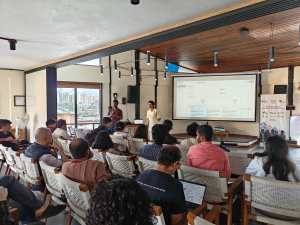
Over four months, the cohort met through virtual sessions, one‑on‑one mentoring, and in‑person workshops that brought together NGOs, technologists, and responsible AI practitioners like Digital Futures Lab and Tattle.
The mindset
The mindset that we set the cohort with was of experimentation, exploration and iteration. The experience was more of being in a lab, testing things out, failing fast rather than spending a lot of time perfecting things. Teams arrived with their questions, trade‑offs, and half‑built ideas. The attempt was to define clearer architectures, pilot, speak to users, pivot, adapt and improve.
NGOs and their use cases
One key thing which made the cohort come alive was how each use case had the possibility of solving a problem for the entire ecosystem rather than just for the one NGO working on it. And it makes you wonder: what would our world look like if we chose collaboration over competition, and created things that everyone could use and build on? Reminds me of Imagine – the song by John Lennon
Imagine no possessions
I wonder if you can
No need for greed or hunger
A brotherhood of man
Imagine all the people
Sharing all the world
Inqui-Lab foundation was trying to answer a simple question: how do you run meaningful student assessments at scale while reducing manual work done by teachers? Their work explored how AI could help analyse student responses more systematically so that teachers could focus on interpretation and follow‑up, not just correction.
Avanti Fellows was trying to solve a different bottleneck. Their mentors have data on student tests, but turning that data into personalised guidance for students takes a lot of time and effort. Can AI solve this and ease the work load? Their solution synthesised this data into notes that teachers could use while sharing feedback and mentoring each student. It highlighted what had changed across tests, where they should focus next and course correct while keeping the human relationship between the teacher and the students intact.
On the infrastructure side, Samanvay Foundation tried to ask if a tech team was even needed for configuring a data platform? They built an AI “copilot” that sits on top of Avni, helping NGOs design forms, define rules, and understand configuration options through plain‑language conversations.
Two health‑focused organisations, SNEHA and IPE Global, used the cohort to push into predictive analytics. Both worked on machine‑learning models to flag high‑risk pregnancies earlier, using program data and public health surveys. The goal was to give frontline workers a better early‑warning system so that the limited resources could be better utilized.
Simple Education Foundation took a more classroom‑centred route by building a chatbot for teachers. This chatbot would almost work like a thinking partner to the teachers and they could ask any questions about their lectures, classes and respond to student needs in real time.
Quest Alliance was trying to create a career counselor for all learners with whom they could ask their doubts, questions and receive customised personalized responses.
Across these use cases, the common thread was that we were trying to reduce the manual effort and we wanted to keep the human in the loop in all cases.
What it really takes inside an NGO
As the months went by, some patterns began to emerge.
The first was limited bandwidth and technical capacity. Product and engineering roles are still a luxury in a sector where most budgets go to program delivery. For some organisations in the cohort, a bit of strategic clarity and periodic check‑ins were enough; they already had internal teams who could prototype once they had the right direction. A couple of organizations really needed the high‑touch hand‑holding, mentors sitting with them in working sessions, co-designing and co-creating solutions
Looking back, three “archetypes” of NGOs became visible:
- Navigator – Those who mainly needed strategic clarity: a low‑touch model, where a few in-depth conversations could unblock them.
- Co-builder – Those who needed deep, ongoing technical partnership: a high‑touch model, where mentors and NGOs effectively co‑built.
- Fund catalyst – Those with clear intent and technical capacity, but for whom funding was the primary bottleneck: where targeted grants could unlock progress.
All the three types of NGOs would benefit from different cohort designs, thus, in future cohorts, we will keep these archetypes in mind rather than assuming one format fits all.
Keeping responsibility at the centre, not the edge
Throughout the cohort, we tried to keep the conversation about responsible AI at the forefront. There were workshops and training led by Digital Futures Lab & Tattle, as knowledge partners, where they asked teams to imagine real people relying on their systems, and then to trace the risks and harms that could follow if the AI got things wrong, or if humans over-relied on it.
Although it might have felt a little early for some teams to think about AI safety, we felt it was important to start that conversation right from the beginning. Even a gentle nudge in that direction helped everyone keep safety at the forefront, instead of treating it as something to figure out at the end.
Regular feedback from mentors proved really important. It surfaced when a use case was too broad, when an NGO was stuck on implementation details, or when two teams could benefit from sharing approaches across domains. It also showed that static cohort designs quickly fall out of sync with the evolving needs of NGOs, playing it by the ear is something that was essential.
Designing the next generation of cohorts
A few clear design lessons emerged:
- Cohorts should be flexible, with room to tweak pacing, and support models mid‑stream.
- Different NGOs have different needs; segmenting support is fairer and more impactful than treating everyone the same.
- Peer learning is a powerful asset when NGOs see how others frame a risk or work with data, their own thinking sharpens.
- Responsible AI and AI safety must be built into the earliest conversations, not just the final documentation.
What stood out at the AI Cohort Program
Beyond the solutions developed and pilots conducted, an ancillary benefit from the cohort was that the participants (both tech and non tech) felt like they could start trying out things, experimenting and using AI to a certain extent.Through the AI Cohort program I feel it showed that with the right scaffolding through cohorts, mentors, responsible AI partners and flexible funding, small and mid‑sized NGOs can meaningfully experiment with AI.