
Making the invisible visible requires more than good intentions – it requires infrastructure built for the work.

In India, menstrual health data exists in fragments. A survey conducted in a Mumbai classroom. Focus groups in remote Rajasthan villages. Kobo Toolbox forms from community health workers, and data collected from women in urban and rural workplaces. Google Sheets tracking workshop attendance. Each dataset tells part of the story. But for organizations working to transform menstrual and sexual reproductive health across the country, the real challenge isn’t collecting data – it’s making sense of it all.
For Karishma Navalkar, who leads monitoring and evaluation at Baala, the challenge is stark. Baala works to make menstrual health accessible, stigma-free, and sustainable for everyone. Given their scale, their data is scattered across multiple contexts. Rural villages, urban workspaces, different types of schools – each context generates its own data, and the more context-specific it becomes, the harder it is to see the whole picture. But visibility requires more than collection. It requires infrastructure.
The Data Infrastructure Question
When Baala began evaluating their data systems, they faced a decision point familiar to many growing nonprofits. Should they change how they collect data? How do they visualize it? How do they analyze it?
The answer, they realized, wasn’t about replacing everything. It was about building the right foundation. Their data collection was working well – what they needed was to get everything in one place and build the pipeline from there.
This is where Dalgo entered the conversation.
Dalgo is purpose-built for the nonprofit sector – designed by teams who understand nonprofit realities. Geographic diversity matters. Context is everything. And scattered data sources are the norm, not the exception.
Why Dalgo: Sector Knowledge Meets Technical Infrastructure
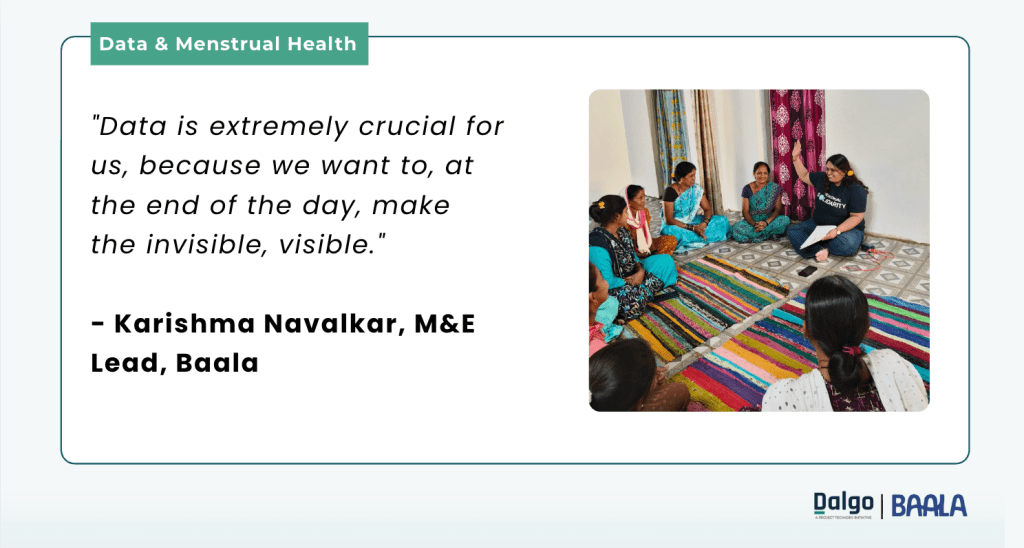
For Baala, choosing Dalgo wasn’t just about technical capabilities. It was about finding a partner who understood their reality.
The Dalgo team had worked with other NGOs before, so they understood what the infrastructure looked like and what kinds of asks would or wouldn’t serve Baala’s future needs. They brought sector knowledge – what dashboards could look like, what effort would be needed before and after implementation. For a small M&E team, that expertise mattered as much as the platform itself.
The value proposition was clear: consolidate every data source – quantitative, qualitative, Kobo Toolbox, Google Sheets, everything – into one place. See trends across programs and geographies. Stop spending time wrangling data and start analyzing it.
But there was something more. Baala didn’t want just another software tool. They wanted differentiation – a way to push beyond basic reporting into genuine insight. The moment that clinched it? Seeing how Dalgo’s upcoming capabilities could generate new insights on menstrual health – looking at age at menarche across different social demographic factors, bridging gaps in visualization that would help them build stronger evidence.
The Adoption Reality: Meeting Teams Where They Are
One of the most important aspects of Baala’s Dalgo implementation is what it doesn’t require: wholesale change to data collection practices. For Baala – recently rebranded from Project Baala – the stakes were particularly high. Their mission wasn’t just about delivering programs; it’s about building evidence in a field where silence has long been the norm. The decision to focus on the second level of the pipeline – the M&E-driven consolidation and analysis layer – rather than changing how field teams collect data made all the difference. Everyone was happy with those changes coming in, because it didn’t complicate their existing workflows.
💡 A key insight for NGO leaders
Field team adoption is one of the biggest barriers to data transformation. By focusing on the processing and transformation layer (data consolidation and analysis) rather than the collection layer (how field teams capture data), Dalgo minimized disruption and resistance. The lesson: Don’t change everything at once.Transform where it creates the most value first.
The Foundation for What Comes Next
For Baala, Dalgo represents the foundation of something larger. With their data finally consolidated, they’re building toward their first comprehensive “menstrual intelligence” dashboard – bringing together parameters critical for policymakers, partner organizations, and their own program teams.
But the vision extends beyond internal use. Baala wants to forge more partnerships with other organizations in the menstrual health ecosystem. They don’t want to gatekeep their data – they want to show it, share it, and invite others to contribute to it.
It’s a reminder that data infrastructure, when done right, isn’t just about organizational efficiency. It’s about building the evidence base that an entire sector needs to move forward.
Ready to Transform Your Data Infrastructure?
If Baala’s story resonates with your organization’s challenges – scattered data, the need for evidence, smaller M&E capacity – let’s talk about what data clarity could look like for you. Book a 30-minute call with us below.
Know your data. Share your story.
Partner Organization: Baala – Making menstrual health accessible, stigma-free, and sustainable for everyone.
