
“In the social sector, participation is rarely about enthusiasm. It’s about what an organisation is willing to carry forward once the excitement fades.”
After wrapping up Phase 2 of the Dalgo Data Confidence Bootcamps in Delhi & Mumbai, I’ve been reflecting not just on outcomes—but on the journey organisations took to even get there, and what that journey quietly revealed.
Registration: What Looks Scattered Is Often Strategic
It began at registration. Organisations signed up for many reasons—some seeking clarity on their existing data systems and processes, some exploring ways to reduce manual effort or strengthen M&E beyond spreadsheets, some assessing whether the real gap was tooling or team capability, and some attending at the request of leadership to see this for themselves. Others came to explore fit and potential collaboration with Dalgo / Tech4Dev, understand the platform and bootcamp in practice, improve funding readiness and donor reporting credibility, or learn how scalable, AI-enabled digital solutions and a public digital good like Dalgo might support their programs.
A few hoped there might be funding support—not opportunistically, but realistically, shaped by an ecosystem where capacity-building is often inseparable from donor pathways, and where scanning credible opportunities is a necessity. Others registered out of curiosity or aspiration—wanting to move forward, but not yet able to pause ongoing operations. Some came looking for volunteers or ways to contribute; others needed help with data collection before consolidation, even when the communication clearly stated otherwise.
On the surface, this diversity of intent can look scattered. In reality, it reflects how NGOs operate while navigating multiple unresolved gaps at once—systems, skills, capacity, funding, and time. NGOs don’t engage only to match stated objectives; they engage to understand where help might exist, what kind of support is possible, and how they might fit into a broader ecosystem of exchange. Seen this way, the behaviour signals resilience and careful prioritisation, not misalignment.
Why “No-Cost” Is Never the Real Question
There’s a persistent assumption in the ecosystem that if something is labelled “no-cost,” organisations will automatically attend. What this overlooks is a deeper reality: no-cost still demands the most expensive resources NGOs have—time, focus, internal alignment, and accountability. Those are often scarcer than money itself. Years of exposure to short-term pilots and extractive learning exercises have also made NGOs cautious about where they place that investment.
Participation isn’t just about showing up. It requires pausing ongoing programs, coordinating across roles, exposing internal gaps, and taking responsibility for what surfaces next. For many organisations, that commitment carries more risk than a financial fee. NGOs are careful because the cost of disengaging midway—or of initiating change they cannot sustain—is high.
Beneath this caution sits an even quieter question:
“Will this truly understand us—or will it become another well-intentioned exercise that collapses once real work begins?”
That question is rarely voiced directly, but it governs decisions far more than price ever does. Seen up close, attendance is not driven by “free versus paid.” It’s driven by credibility, contextual understanding, and the belief that the work will meet organisations where they actually are.
What These Bootcamps Actually Are (and Why That Matters)
One quiet but important learning from this process is that what we’re doing with the Dalgo bootcamp isn’t “capacity building” in the conventional sense. It isn’t about transferring skills in isolation or running a generic workshop. It’s about creating a space where organisations can experience the value of a data platform through hands-on work on their own real use cases, see how similar NGOs have structured their systems, and understand—practically, not theoretically—what adoption would actually require.
In practice, the bootcamp functioned less as training and more as a diagnostic and decision-making environment. By working directly with their data, teams began to see their own bottlenecks more clearly—where systems break, where ownership is unclear, what can be automated, what cannot, and what trade-offs they would need to accept. Often, organisations learned as much about their internal priorities, team strengths, and readiness for change as they did about the platform itself.
This framing matters because the value isn’t just in “learning something new.” It’s in helping organisations decide—without pressure—whether a platform fits their context at all, what it would replace or complement, and whether it can be sustained over time. Clarity, in this sense, is the outcome—not adoption.

Fitment Calls: Where the Real Conversation Begins
The next stage was fitment and discovery calls. From the outside, these can look procedural—another step in the funnel. In practice, they were often something else entirely.
For many organisations, this was the first sustained conversation where someone stayed long enough to ask why—and then sit with the discomfort of asking it again. That pause mattered. It created space for realities that rarely surface in formal presentations: concern about introducing yet another system that might outlast neither the grant cycle nor the team managing it, pressure from donors to “show something” quickly, teams already stretched thin, and a quiet fatigue shaped by tools that promised clarity but delivered more complexity.
What also emerged was responsibility—not abstractly, but personally. The weight carried by people who know that the numbers they produce influence funding, program direction, and real lives on the ground. Hesitation here wasn’t resistance; it was care.
Platform demos and scoping conversations followed. When organisations asked about dashboards or tools, it could easily be read as solution-shopping. Seen more closely, it was usually a confidence question: Can I trust this data when I stand in front of leadership, a board, or a donor?
The real work in these conversations wasn’t about features or interfaces. It was about separating signal from noise—understanding what genuinely needed fixing now, what could wait, and what trade-offs an organisation was actually prepared to live with.
Sometimes the most responsible outcome of a demo is deciding not to adopt—yet.
Choosing Depth, Not Motion
Shortlisting organisations was never about exclusion; it was about depth, responsibility, and honesty. This format works only when there is high intent—not just curiosity—an emerging articulation of the real problem rather than a symptom, and a readiness to confront data chaos at its roots instead of layering another platform on top.
Working closely with fewer organisations made it possible to sit with complexity long enough for it to reorganise itself into clarity—tracing issues upstream into definitions, ownership, incentives, and field realities. Shortlisting wasn’t a filter for “readiness,” but a commitment to do justice to the work.
Governance, DUAs, and Responsible Pacing
Governance and DUA conversations followed, unfolding in more than one responsible way. Some organisations moved ahead with DUAs early, signalling readiness to work with live data and clear internal mandates. Others chose to begin with dummy or anonymised datasets—allowing teams to learn the system and its implications before introducing sensitive data.
Both paths reflected seriousness. What mattered wasn’t speed, but intentionality. In many cases, slowing down here marked a quiet shift from exploration to accountability.
Who Stayed, Who Stepped Back—and Why That Matters
Some organisations dropped off along the way—not because they lacked intent, but because the nature of the work revealed itself more clearly over time. What initially looked like a workshop turned out to be a commitment. Recognising early that they couldn’t make that pause was often an act of responsibility.
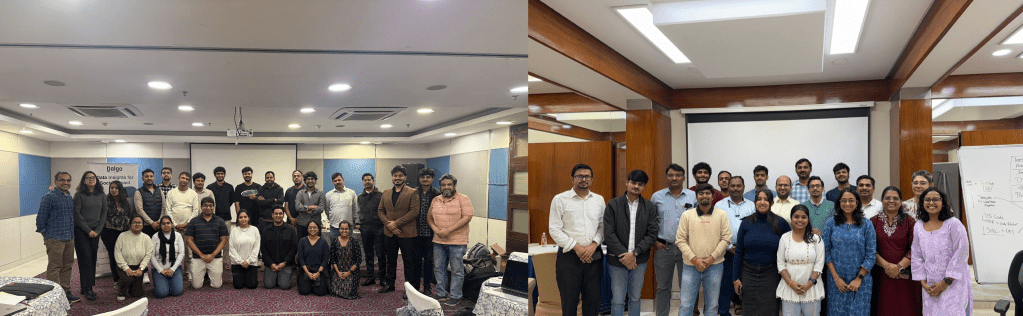
For those who made it to the bootcamp, what emerged wasn’t just learning, but relatability—the relief of realising that confusion, fragmentation, and trade-offs are shared conditions. Many arrived asking for dashboards; most left recognising that fragmented collection, unclear ownership, brittle transformations, and misaligned roles were the real constraints.
Even organisations that didn’t participate fully still gained value. Early conversations alone helped many clarify what mattered now—collection or consolidation, skills or platforms, framing or process—and what they could realistically sustain.
The Deeper Learning
Across the entire journey, one pattern surfaced again and again. What appears from the outside as hesitation, indecision, or slowness is often something else entirely on the inside: care—for people, for systems, and for consequences that don’t end when a program does.
One quiet learning from all this is that the reasons we, as service providers or ecosystem actors, often assume are rarely the real reasons. Only by asking why—and then asking it again—does the deeper story emerge. And that story should shape how solutions are designed, funded, and supported.
Because data maturity in the social sector isn’t a technology problem.
It’s a clarity, alignment, and confidence problem.
And clarity doesn’t come from workshops alone. It comes from creating space to listen, reflect, and sit with complexity long enough for better decisions to become possible.
Sometimes the most valuable outcome isn’t adoption—it’s the confidence to choose well.
A Note of Gratitude
Before closing, it feels important to acknowledge the people who made this journey possible beyond the framework and facilitation.
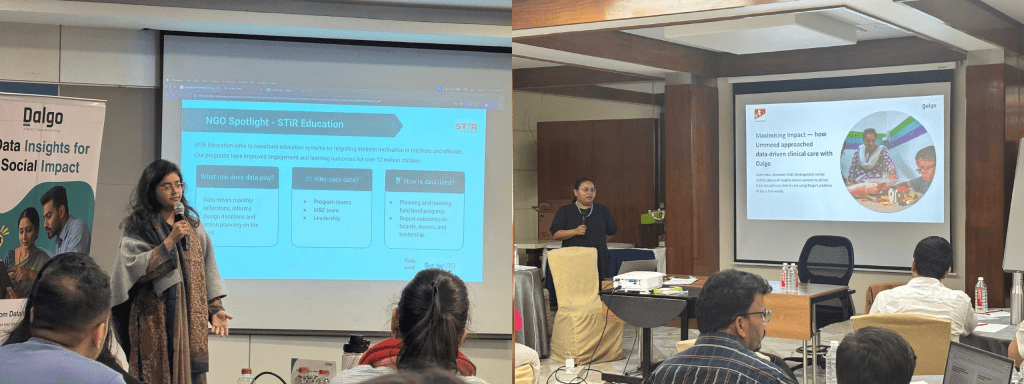
A sincere thank you to our current partner organisations who took time out from their already demanding work to join the bootcamp and share their journeys with Dalgo—what worked, what didn’t, what they had to unlearn, and what adoption actually looked like in practice. Their willingness to speak honestly, without polish or pitching, grounded the conversations and gave participants something far more valuable than theory: lived experience.

Grateful to the Dalgo team for standing behind this work—showing up with patience, rigour, and deep care at every step, which clearly reflected in the feedback and testimonials shared by participants.
A quiet thank you to the team behind the scenes—coordination on the D-Days, service, and venue support—whose thoughtful execution made the space for real engagement possible. This kind of work is never the outcome of a single role or function. It’s the result of many people caring enough—about details, about context, and about each other—to make space for meaningful work to happen.