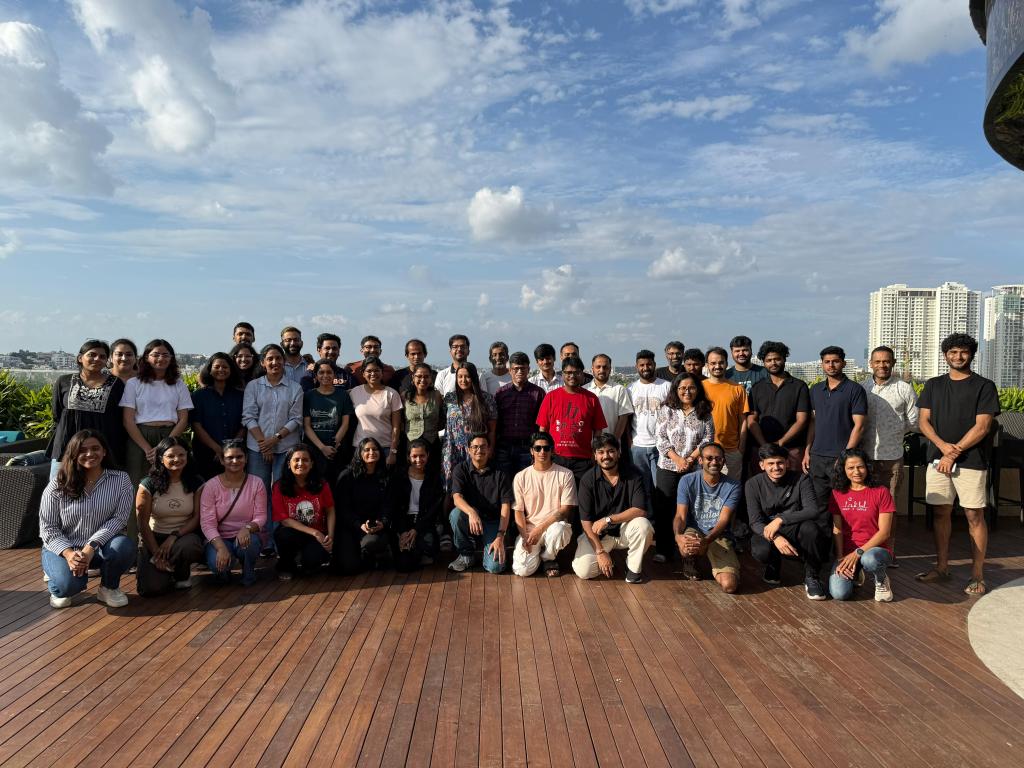
For the past two weeks, Tech4Dev teams were scattered across India—some hosting events, others quietly observing the social sector up close. We packed an unbelievable number of activities into this period: the Developers’ Sprint at Quest Alliance’s Observatory, a CTO event in Mumbai, Glific Launchpad in Delhi, the DALGO bootcamp in Bengaluru, the AI Cohort meetup, and Glific as well as DALGO ‘s NGO sprint. It still feels surreal that all of this happened in just two weeks.
For this blog though, I’ll focus on what I personally experienced and resonated with the most: the Developers’ Sprint, the AI Cohort, and NGO visits.
Week 1: NGO Immersions (8–12 September)
We visited three NGOs during the first week. Four of us—Akhilesh, Amisha, Akansha, and I—spent time at two of them: ATREE (Ashoka Trust For Research In Ecology And The Environment) and Reap Benefit (which is an organization working towards empowering youth to be able to take actions towards civic and climate issues). Both offices had their own kind of magic.
ATREE

Everywhere you looked, nature framed the day—ponds with fish, trees and plants, even spider webs glittering in the sunlight. Because ATREE also offers a PhD program, the NGO building includes research labs, classrooms, and libraries focused on ecology.

Conversations there (and later throughout the sprint) kept circling back to a grounding truth: technology isn’t the change—it’s an enabler of change. Even after years in this sector, individual impact can feel like a drop in the ocean. But that’s exactly the motivation—many drops can become a drizzle, and a drizzle can turn into something larger.

Reap Benefit

Beyond meeting RB’s very adorable office cat, we spoke about their student hackathons. Students explore real-world problem statements, propose solutions, and sometimes even build prototypes. Judges range from teachers to government officials, which helps students understand feasibility and hear diverse perspectives. Our visit was brief—we had to head to our next stop: Quest Alliance’s Observatory, where the Developers’ Sprint would take place.

Developers’ Sprint at Quest Alliance’s Observatory
Quest Alliance’s Observatory is as thoughtful as it is beautiful. Sustainability shows up everywhere—from composting leftover food to passive cooling with water running through walls, and with these two facts I am just scratching the surface. It was the perfect setting for a three-day sprint where Tech4Dev developers worked, learned, and hung out together.

I won’t unpack every session (there were five in total: four by Tech4Dev teammates and one by Quest Alliance people on their respective journey in the social sector), but I do want to highlight the session that kicked things off: System Design Thinking by Devi. It covered a structured approach to system design and core considerations—why systems thinking matters, multi-tenancy, first-principles thinking, and more.

A few topics I noted to dive deeper into later:
- Using Postgres stats to understand table usage (e.g., which tables are hit most),
- Table partitioning,
- Row-level security for tenant isolation,
- Horizontal vs. vertical scaling,
- And a pragmatic alerting principle: not every error is “page-worthy.” For example, routine “not found” errors shouldn’t wake up the on-call.
Maybe there’s a future blog in here—I’m genuinely enjoying this area right now.
Week 2: AI Cohort (14 & 16 September)
The first in-person AI Cohort meetup brought its own threads of sessions and discussions. If you’re hearing about it for the first time: the cohort is designed to help NGOs bridge the gap between their needs and what AI can responsibly offer. Tech4Dev, along with Digital Future Labs (DFL) and Tattle, is mentoring participating NGOs as they design pilotable Responsible AI solutions. We’re helping with guidance, design, and resources tailored to their goals, while DFL and Tattle anchor the ethics and governance aspects.

For the cohort, I am mentoring alongside Vijay for Quest Alliance’s learning assistant bot. The cards were already in our favor—we’d met the Quest team during the Developers’ Sprint at their own space—so the two cohort days let us dig deeper into the solution.
All the NGOs participating in the AI Cohort gave a quick description about their use case for the cohort. out of the 7 NGOs we are working with, two of them are health sector NGOs with an use case almost similar to each other, and four of them are education sector NGOs whose use cases are not exactly same but they still have some common grounds with each other.
Sessions that happened in the two day AI cohort event:
- LLM observability with langfuse (by Aviraj) and evaluation (by Rajshekar)
- Responsible AI sessions facilitated by DFL (including a hands-on activity on over-reliance on AI) and Tattle (walkthroughs of guardrail approaches they have built using curated lists, moderation LLMs, and related checks).
Our cohort team—Steven, Tanisha, and Sunil from Quest, with Vijay and me from Tech4Dev—has been fantastic to work with. The conversations are rich, practical, and honestly, a lot of fun.
Wrapping Up
After the cohort, the Kaapi team focused on platform enhancements and a bunch of design choices behind them. And just like that, the two weeks were over. Writing this, it feels like I lived several lives in fourteen days. Excited to see what the future contains for us as a team.