
Thanks to a generous grant we received a few weeks ago, we are embarking on an exciting new journey, which brings us back to Tech4Dev’s mission: Build and support the software, data, design companies, nonprofit partners, and foundations ecosystem, creating global social impact. The grant has multiple components, but one we kick-started was building a collaborative of software partners. During the meeting, one of the participants mentioned that this was a repeat of an event we did when Tech4Dev had just started, way back in April 2019.
Thanks to the blogging culture, I knew we had to have produced some blog posts about the event. AI and Google were both equally useless and were of no help 🙁 Tried a new approach and went to the first-ever blog and worked backwards, and lo and behold, found the following two blogs:
- The Evolution of Tech4Dev by Arjav
- Recap of T4D Project Conference by Lobo
This time around, we had 6 ecosystem partners and a group of 14 people around the room.
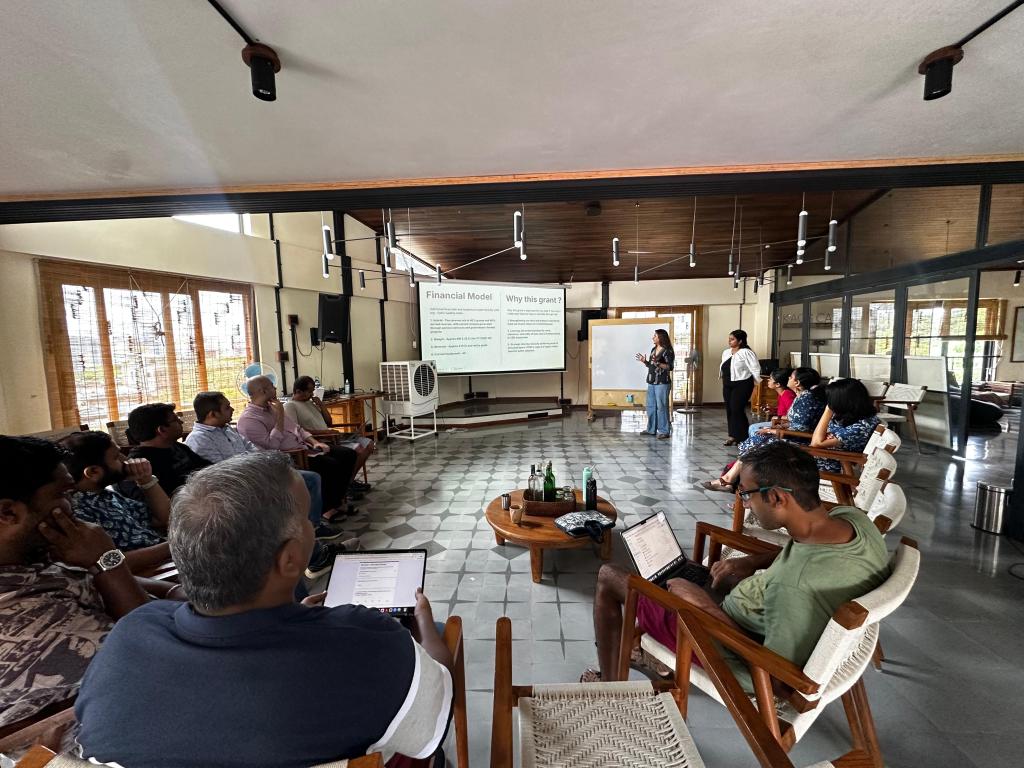
My colleagues, Ashana S and Aishwarya S did a wonderful job from logistics and event coordination to creating the agenda and giving us ample homework before the event. Since many of us were meeting for the first time, and learning about each others work, we spent a large part of the first day getting to know each other, the work we are respectively doing and the type of NGOs, government and partners we work with. We also spoke about the grant, the project and our proposed approach. For this curious, you can read more about it here: The Agency Fund Capacity Building Grant
A few thoughts and reflections:
- It was surprising (and a bit sad) to realize that many of the orgs were not aware of each other. And these are some of the more active orgs in the ecosystem.
- Not as shocking, but still a jot of how small the budgets are (the largest org in the group had a budget of a bit more than 5 CR, the smallest, 50L)
- All of us had the same problem, getting enough customers at a predictable pace and raising enough money to keep the business alive and hopefully growing.
- The group as a whole was super optimistic from what the future holds perspective. Many of us had very optimistic projections from a revenue / clients perspective. but seems like we need to do this to keep us motivated and to push forward.
- This time around, we intentionally broadened the group to be a lot more diverse than just software providers. The group include a legal firm (Pacta), a group working on a healthier online ecosystem (Tattle) and a team working on strengthening civic engagement via open data. So the conversations were more at a higher level than a technical deep dive.
- The conversations on a potential technology conference for the sector and collaborating on future cohorts was interesting to see how different people interpret how they would like to see things unfold. In specific, I did like Naren’s (from Tamaku) framing on the goals of a gathering should be to: Learn, Network, and Advocate.
- Everyone really appreciated the opportunity to meet and spend time with their peers and colleagues, where they could have honest and open conversations and have a community that Kida understands their struggles and problems.
- Unfortunately, we did mess up, and missed a few important players from the sector. It was a miss on our part, and we’ll do a second round with a few more important ecosystem partners. Please do ping us, in case we missed you and want to be part of the ecosystem. Our essential criteria is you are working with a significant number of NGOs.
So has anything really changed in the last 7 years? The answer, in my opinion, is yes and no.
- Yes: the number of ecosystem partners and folks offering services in different areas has grown significantly. The amount of money being invested in the tech/data/AI ecosystem is far more than it ever was. The number of NGOs using our services and tech has increased by leaps and bounds.s
- No: it’s still hard to run a successful NGO or social impact organisation. For many orgs, it’s important but not a priority, or they don’t have the money/resources—still a challenge to convince funders to support sectoral work.
But overall, I do think we are in a much better place today than we were 7 years ago.
Onwards and Upwards
