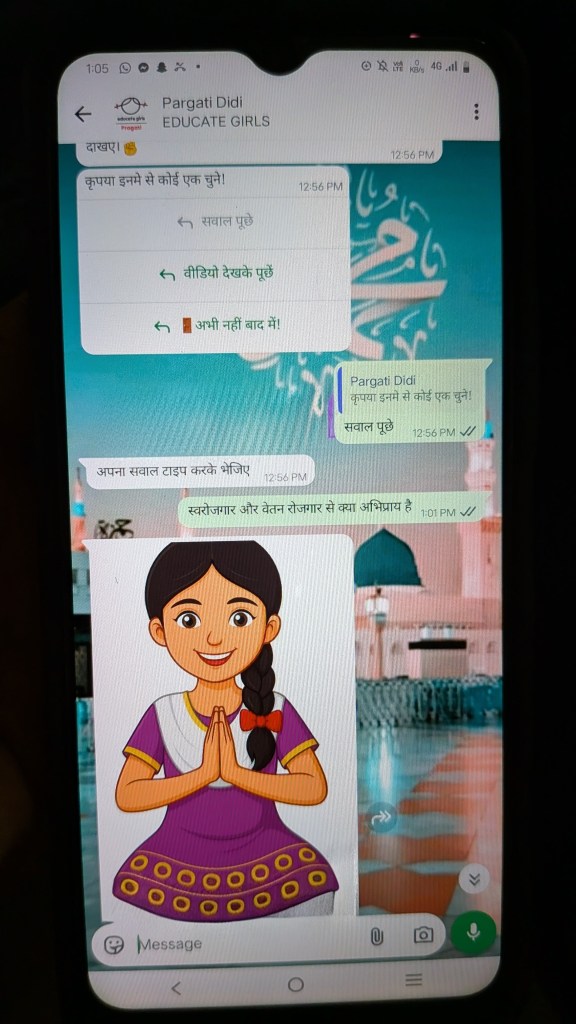
As part of my fCxO engagement with Educate Girls, I’ve been working on Pragati Didi — a WhatsApp chatbot helping girls and women who had to leave mainstream education prepare for their 10th grade Open Schooling examinations. Last month, we launched the Ask module pilot in Bihar, where learners could bring their doubts to Pragati Didi and get responses as there were no subject matter experts involved in the program. As we worked towards its full launch for the next cohort, we felt there was no better time for a field visit — to meet the learners, understand their realities firsthand, and let the ground teach us. This is my first field visit and first time in Bihar too. There were moments I silently wished I had learned to speak in Hindi properly.
The Team
Krishna, my product counterpart, couldn’t join but made sure nothing was left to chance — working to the minute detail on camp selection, interaction formats, and questionnaires. In Patna, we were joined by Navneet, a data analyst who knew every corner of the chatbot and its evolution, and Jayesh, Bihar’s State Impact Senior Specialist at Educate Girls, who brought ground-level knowledge. Tanu, a Product Analyst from our team, happily agreed to join me in the field visit and had the kind of natural energy, people skills and easy Hindi that opened every room we walked into. And me — just there to listen and observe.
The Women We Came to Meet
What stayed with me most from this trip wasn’t the data or the product gaps — it was the women themselves.
They are aged between 14 and 30, navigating difficult socioeconomic conditions, and yet they show up. To camps, sometimes with their children in tow. From kilometres away, through pouring rain and scorching heat. To sit together, open their books, and prepare for an examination after they left school years ago, knowing very well that it’s going to be hard. Their reasons for leaving mainstream education vary, but their determination to grab this second opportunity as they put it, is something else entirely. And what moved me most was the maturity of some of the young girls, who didn’t see the exam as the goal, but as a step forward, to face whatever life brought next.
The Camps
We visited 6 camps across Munger and Katihari — diverse by design, covering different levels of chatbot engagement, camps where the Ask module pilot had run and where it hadn’t, and some run through partner organisations. Each had its own distinct vibe — some in preraks’ homes, some in learners’ homes, others in anganwadis or schools.
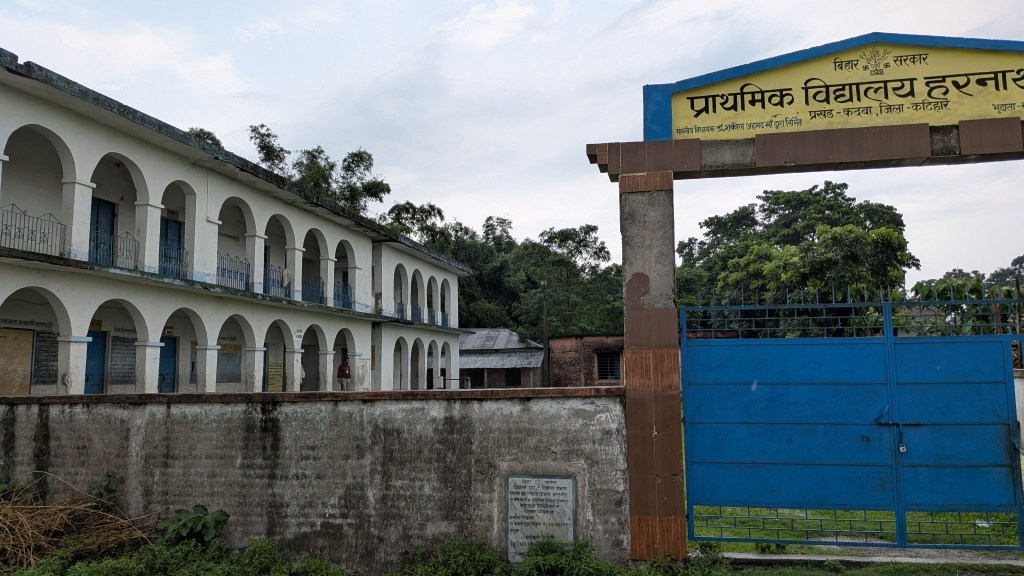
The early atmosphere reminded me of a DEO visit during school days — tense, a little formal. It eased slowly as conversations turned to Pragati Didi and the room came alive. We heard learners describe, with gleaming eyes, how a small word of appreciation from the chatbot after a quiz meant a lot more to them than we’d imagined. We heard innocent questions — why are the quiz questions always the same? And we couldn’t help but smile when some of them assumed Tanu herself must be the Pragati Didi answering their messages on the other side.
What the Ground Taught Us
We came back with a long list — gaps and inconsistencies in the chatbot, content, UI/UX, operational processes, and feedback loops within Pragati Didi. Watching learners interact with chatbot, getting a glimpse of them doing their own self-assessment of mock tests from the previous day, seeing how complex the feedback loops are for both learners and preraks, and so many more — all of it pointing to what we could change to help these learners. A detailed report is coming. But two things stood out immediately.
We had almost finalized Speech-to-Text as the next feature to rollout, knowing that typing was a friction point for many learners. The ground had already answered that. Some learners had independently discovered voice typing on their own — entirely unprompted. That was a quiet reminder that there’s no substitute for observing your users directly.
The other was understanding where the deepest struggle lies — and where Pragati Didi could make a real difference. Learners told us clearly what they need: most is help structuring “panch number aur das number questions” — 5 and 10-mark answers. Longer-form responses are where they feel most lost, and where a thoughtfully designed tool could do the most meaningful work.
The visit was an amazing opportunity for me to connect with the learners and learn from them. It brought in a lot of clarity of what the potential 90/10 solutions are, for Pragati Didi. I’m excited more than ever to work with Educate Girls, helping these girls and women, in taking a step towards their dreams. Some of the other memories that I took back: The gentle and glowing Ganga at sunset. A dolphin’s fin briefly breaking the surface. Eating whatever we could find – samosas, sattu or chaat for some of the meals. The warmth and quiet of the villages.