
In my second week at Project Tech4Dev, I had the opportunity to travel to Rishikesh for the kickoff workshop of the AI Cohort Program 2.0. As someone who had just joined the team, it was an interesting way to step into the work Tech4Dev does, bringing together nonprofit organizations, technologists, and mentors to explore how AI can support real challenges in the social sector.
The two day in person workshop marked the beginning of the next phase of the AI Cohort Program, where participating organizations will spend the coming months refining and prototyping AI solutions tailored to their program needs. For me, it was both an introduction to the cohort and a chance to see how these collaborations begin through conversations, problem framing, and early experimentation.
What the AI cohort program is all about
The AI Cohort Program brings together nonprofits that are interested in experimenting with AI to solve specific challenges in their work. Rather than starting with the technology itself, the focus is on identifying real program problems and then exploring whether AI could meaningfully support a solution.
Over the next few months, organizations in the cohort will work closely with mentors to refine their ideas, understand their data, and develop early prototypes. The workshop was designed as the starting point for that process, a space to meet, share ideas, and begin shaping the use cases.
Returning organizations: Taking the next step
One interesting aspect of this year’s cohort is that a few organizations are returning after participating in the previous cohort. These teams had already started experimenting with AI pilots and are now coming back to continue building on those ideas.
The returning organizations include:
- Inqui-Lab Foundation
- Avanti Fellows
- Samanvay Foundation
Having them in the room added a useful layer to the conversations. They were able to share what worked, what did not, and what they learned from their earlier experiments.
You can read more about their journey in Cohort 1 in the blog written by Ashana.
New organizations joining the cohort
Alongside the returning teams, several new organizations have joined the program this year:
- U&I
- Reap Benefit
- Madhi Foundation
- Glific
Each organization is approaching AI with a different problem statement and context. Some are thinking about how AI could support internal decision making, while others are exploring tools that might help frontline teams or improve how they work with program data.
Seeing such a variety of challenges in one room made the discussions especially interesting. At the same time, there were also similarities in some of the use cases, which led to a lot of cross learning even in the early stages.
Day 1: Getting everyone on the same page
The workshop started with quick introductions from each NGO. In just a few minutes, each team shared what their organization does and the challenge they are hoping to explore through the cohort.

This was followed by a session on AI safety and guardrails, which set the tone for the program. The conversation focused on building AI systems that are responsible, transparent, and safe to use, something that becomes especially important when working in the social sector.
The Tech4Dev team also demonstrated some of the tools developed through Kaapi, showing how organizations can think about building guardrails into their systems from the start.
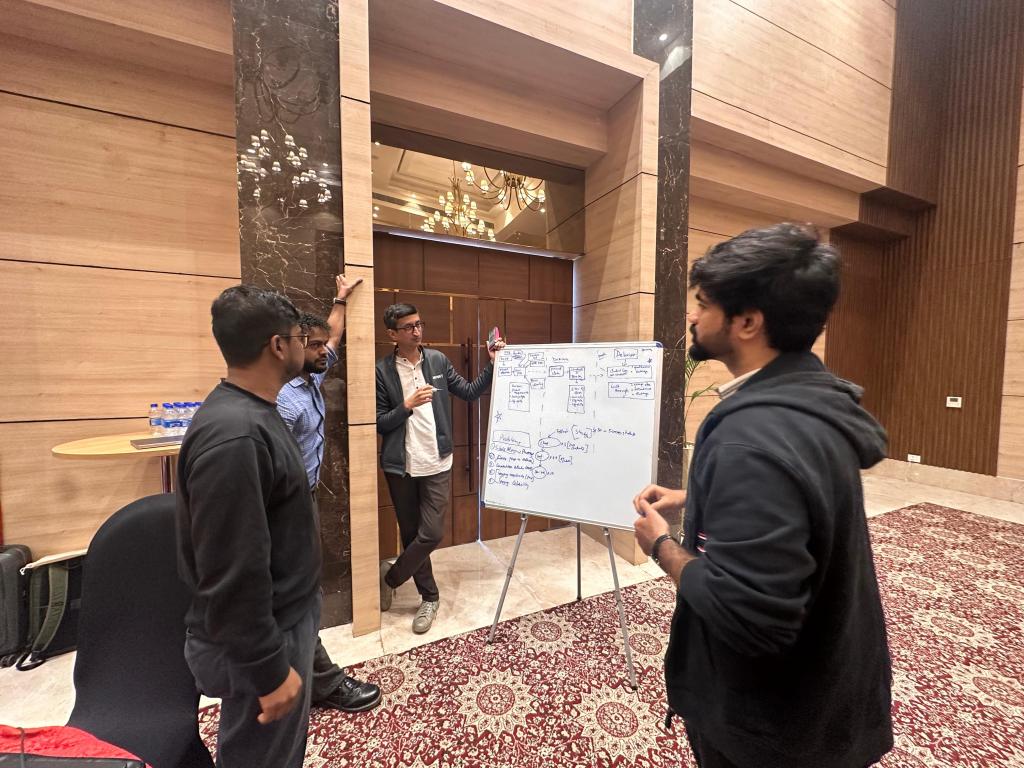
A large part of the afternoon was intentionally kept open for mentor mentee working sessions. This was where things got lively. Teams huddled together, sketching ideas, debating approaches, and trying to translate their broad problem statements into something more concrete.
Day 2: From problems to possibilities
If Day 1 was about understanding the problem space, Day 2 shifted toward thinking about possible solutions.
Later in the day, Reap Benefit led an engaging session on behavior change and technology. It was a good reminder that even the most sophisticated tools do not create impact on their own. People have to adopt and use them in meaningful ways.
Rajagopal led a session on design thinking and AI prototyping, encouraging organizations to break down their use cases into smaller components and consider how AI might assist specific parts of a workflow.
By the end of the second day, many teams had already started reshaping their original ideas.
A familiar organization in a new context
One moment during the workshop stood out for me on a more personal level. Among the organizations in the cohort was U&I, an organization I have previously volunteered with.
Having seen their work from a volunteer’s perspective, it was exciting to now see them thinking about how AI could support their programs. Watching an organization you have been connected to explore new tools and approaches makes the conversation feel a lot more real. It is no longer just about technology, but about how it might actually support the work happening on the ground.
Looking ahead
The kick off workshop was only the starting point for AI Cohort 2.0. Over the next few months, these organizations will continue working with mentors to refine their ideas and experiment with building prototypes.
For me, it was a pretty memorable way to spend my second week at Tech4Dev. Instead of slowly easing into the program, I got to see it in action, meeting the organizations, hearing their ideas, and watching the first steps of what might eventually turn into real AI tools for the social sector.
And if the energy from those two days is anything to go by, the rest of the cohort journey should be a very interesting one.

