Some journeys start long before you reach the destination. Mine started at the boarding gate.
We were in Guwahati for a two-day workshop with 12 NGOs, where we would share SANGAM, the AI tool our team had been building for the past two months.
Day 1: Know Yourself First
Day 1 was built around one idea: know yourself before you approach the funder. We started with a simple exercise. Everyone wrote down one hope, one worry and one thing they could offer the group, and stuck them on a wall to revisit on the last day.
Then came a moment of honest reflection. Each NGO wrote down every funder it had worked with, grouped them by type and counted how many years each one had stayed. Some funders had been there for years and some had left quietly. Seeing it all on paper raised the big questions: why did some stay, and why did others walk away? The answers showed each NGO what makes a funder stay for the long run.
Through fun, hands-on activities, NGO members took turns acting as funders, NGOs and communities to see how each one depends on the others. Then they dreamed big, sketching out where they want to be in five years and what it will take to get there.
For us, this was the best way to get to know them. Every activity showed us what each NGO works on, the programmes it runs, the communities it serves and the challenges it faces in raising funds. During breaks, we went up to them, pulled up chairs and sat in on their discussions. By the end of the day, these weren’t just 12 names on a list anymore. We understood their work, their goals and their stories.
Conversations That Stayed With Me
I spoke with Amruta from Projonmo, who teaches children with special needs. She explained that every child learns at a different pace, and that their levels of patience and attention are not the same as other children’s. Teaching them cannot follow one fixed method. It takes time, understanding and a different approach for each child.
I also spoke with Margaret from MOSONiE Socio-Economic Foundation, a women-led organisation in Meghalaya’s Ri-Bhoi district. She pointed out that the small “i” in MOSONiE stands for “me”, a quiet reminder of the individual within the collective. This fits the organisation’s philosophy of “less of me, more of us”. MOSONiE works with rural communities on livelihoods, women’s health and environmental regeneration. Margaret was curious and asked us many questions about what we were building. She also shared a challenge her team faces today. Over the years they have gathered a lot of data, but it sits in many separate Excel files. Whenever they need to share their numbers and analytics with a funder, someone has to go through each file by hand to find them.
Our Turn to Present SANGAM
Then it was our turn to present what we’d been building, and I learned something I didn’t expect.
Presenting a solution doesn’t mean jumping straight to what you want to show. Vinod built the slides so the story unfolded step by step, and the flow was what made it work.
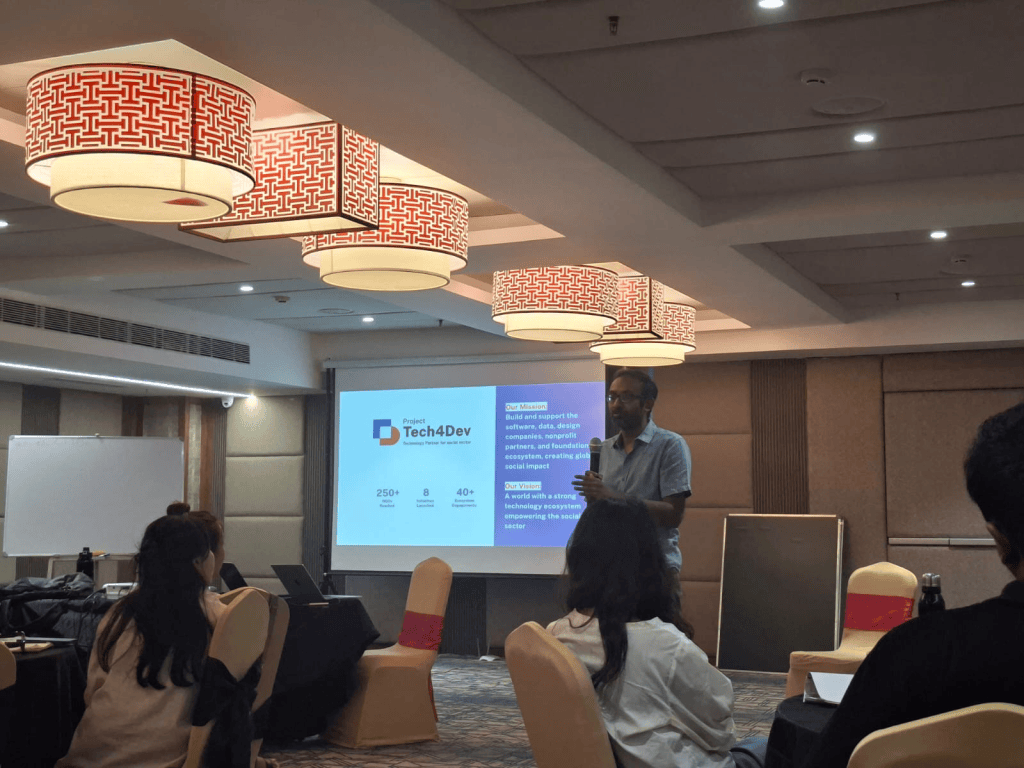
He started with who we are and what our organisation does, so the room knew us before they saw anything we’d built.
then walked through the fundraising journey every NGO already knows and showed how SANGAM fits into it, from opening a saved funder match to writing a proposal from your own facts, spotting gaps and exporting it to Word to polish.

One of our advisory members drew four circles on a whiteboard, each with a single letter inside. It was just one of many things we learned over the two days, but it stayed with me the most. Listening to it felt like watching years of experience turned into four simple letters.
P is for Problem Statement. Before anything else, an organisation must be clear about the problem it is solving. Who is affected, how big is it, and why does it matter?
D is for Differentiation. Many organisations work on the same issues. What makes your approach different, and what evidence do you have that it works?
M is for Money. How much is needed, and what will it be spent on? A funder wants to see the goal and the numbers behind it.
W is for Why Philanthropic. Why does this work need philanthropic funding? An organisation should be able to answer that clearly.
The advisors shared so many meaningful insights over the two days. All of it showed how important the right guidance is, and I could have kept listening for hours.
Day 2: The NGOs Take the Stage
If Day 1 was about getting to know each other, Day 2 belonged to the NGOs.
All 12 organisations pitched their proposals, and this was my favourite part of the workshop. Each pitch was a window into the organisation: what it does, who it works with and why it matters. In just a few minutes, I understood their work in more depth than any brochure could have shown me.
Some NGOs didn’t just present numbers and plans. They told stories. Those pitches stayed with me long after they ended.
At the end of the day, three NGOs were awarded prize money for their pitches.
The Story That Won First Prize
First prize went to Projonmo, an organisation that works with children with special needs.
What made their pitch stand out was a story. They shared the journey of two children, and in that moment, the whole room was listening. No slides or statistics could have said it better. It reminded me that behind every proposal are real people, and a story told from the heart can move anyone, including a funder.
After these two days, SANGAM feels more personal to me. The NGOs we met are no longer just users we’re building for. They are people with real stories and real goals. I’m excited to keep working on SANGAM and to see it make the funding journey easier for organisations like these.