

What began as a soccer ball and a dream grew into a movement that has transformed urban slums in Kenya. In 2004, Kennedy Odede, a street child in Kibera, witnessed how his community came together in times of hardship. That experience shaped his belief that communities are not problems to be fixed but sources of solutions when given the right support.
Today, Shining Hope for Communities (SHOFCO) mobilizes grassroots networks across Kenya in health, education, WASH, livelihood training, microloans, community organizing, and schools. Its flagship initiative, the SHOFCO Urban Network (SUN), empowers residents to lead local change with services rooted in dignity and equity. Over the years, SHOFCO has grown from a small sports program to an award-winning leader in urban slum transformation, recognized globally by TIME100, Nelson Mandela Prize and the Hilton Humanitarian Prize.
SHOFCO now reaches over 2.4 million people living in urban slums. With this scale came increasingly complex operations, and the systems used to manage and analyze data were under strain. The organization’s data strategy had been built on a drive to centralize everything into a single platform, most often CommCare. While well-intentioned, this approach created brittle systems that were difficult to adapt, and it left many programs struggling to fit their needs into a one-size-fits-all mold.
The Challenge: Centralization Without Flexibility
2022 – Fragmented Beginnings
By 2022, SHOFCO was running multiple programs across health, education, gender, and livelihoods, each collecting large volumes of data using different tools. While this allowed programs to operate independently, it created serious inefficiencies:
- Manual bottlenecks – Teams spent significant time cleaning, merging, and preparing reports.
- Delayed donor reporting – Manual processes couldn’t keep pace with reporting requirements.
- Slow decision-making – Leadership lacked timely insights to guide data-driven decisions.
The need for a more integrated, scalable approach became increasingly clear.
2023 – Attempt at Centralization with CommCare
In 2023, SHOFCO embarked on a digital transformation to unify program data. CommCare was selected as the central data collection platform, with a modern data engineering stack built around Airbyte (ingestion), dbt (transformation), and Power BI (visualization) hosted on SHOFCO’s AWS infrastructure.
However, centralization came with trade-offs:
- CommCare misfit – Some programs (e.g., Health, Education) needed specialized LMIS or HMIS solutions. Forcing CommCare led to staff frustration and workarounds like paper records, pinned charts, and ad hoc Google Sheets.
- Bugs & adoption gaps – Field teams struggled with bugs and poor user experience, which slowed adoption.
- Leadership vs. operations – Power BI dashboards catered to leadership but offered little value to frontline workers who needed case-level insights, particularly in sensitive areas like GBV.
Centralization gave the illusion of integration, but workflows were bending to fit the system instead of the system adapting to program needs.
2024 – Transition and Rethinking Flexibility
Define Africa was brought in as SHOFCO’s data and CommCare engineering partner, alongside Tech4Dev as fCxO. A key shift in strategy followed:
- Selective fit – Programs like Gender and Sustainable Livelihoods continue to use CommCare, while Health and Education explore domain-specific LMIS/HMIS solutions.
- Operational challenges – Maintaining the Airbyte–dbt–Power BI stack on AWS is costly, as SHOFCO lacks in-house resources and depends on external retainers. Airbyte pipelines—set up as multiple API streams—are difficult to troubleshoot and scale.
- Cost barriers – Extending Power BI dashboards across the organization would be prohibitively expensive, especially for sensitive, operational-level dashboards.
The focus then was on flexibility without fragmentation—rethinking connectors, building field-relevant tools, and adopting program-appropriate platforms – which is what led SHOFCO to Dalgo.
Why Dalgo
In October 2024, SHOFCO began working with Dalgo to change its approach. The aim was not to discard existing systems, but to give each program the freedom to use the tools that suited its work best while still connecting all data for transformation and analysis. Dalgo became the foundation for this change.
Dalgo allowed SHOFCO to collect data from multiple sources without requiring every program to operate within the same software. CommCare could continue to serve programs where it was a good fit, but other systems could also be used. Dalgo pipelines, powered by DBT, now ingest data from CommCare, many Google Sheets, and the Mobiwater API, with plans to add their LMS, Monday.com, and Susteq API. All of this data is cleaned, transformed, and stored in a unified analytics layer that can support any number of reporting or visualization tools.
Dalgo’s Intervention

Dalgo’s role began with centralizing intelligence rather than interfaces. Programs kept the tools that worked for them, but their data was combined into a single source of truth. This made it possible to create accurate maps of programs and facilities, track key metrics across sectors, and generate insights in real time.
The next step was designing dashboards in Superset that would actually be used.
- Leadership had Dashboards with high-level KPIs to support strategic planning.
- Donors had donor-specific dashboards built with emphasis on the KPIs donors cared about.
- MEL & Program teams could see adoption patterns and adjust tools accordingly. They could track what was happening in their programs without relying on updates from case-workers. This helped them identify problems in their programs before they ballooned.
- Caseworkers were given dashboards with row-level security that displayed only their own caseload, including the number of cases assigned, the status of court cases, and the number of people in safe houses. For many caseworkers, this was the first time they could track their work digitally without relying on memory, sticky notes, or handwritten wall charts.
Dalgo also focused on strengthening SHOFCO’s internal capacity. Over 40 hours of in-person training helped IT and MEL staff develop the skills to write SQL models, build dashboards, and maintain and troubleshoot data pipelines. Some staff who previously worked in purely support roles are now designing data models and managing analytics for their programs.
With Dalgo in place, SHOFCO was able to test new workflows quickly and scale the ones that proved effective. New data sources could be integrated without disrupting existing systems, and the timeline for rolling out new dashboards dropped from months to days.
Impact on SHOFCO’s Operations
Case Workers and the MEL Team used to spend 12+ hours per week cleaning, aggregating and analysing data. It was a repetitive, manual and laborious process. After Dalgo’s intervention, time was only spent validating data, which came down to around 2 hours per week.
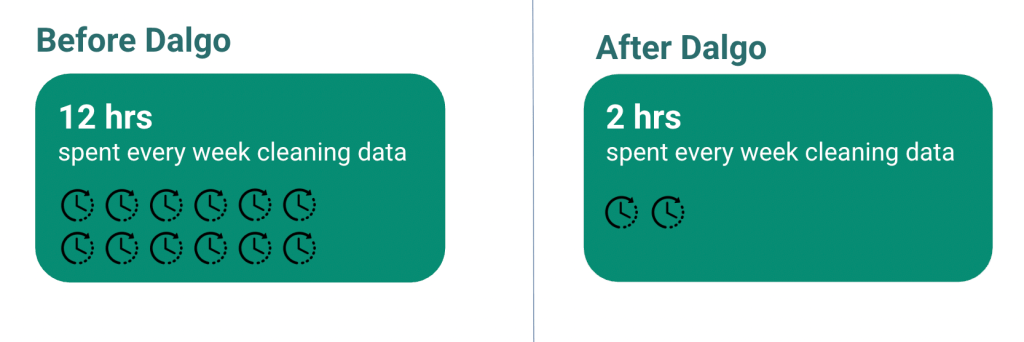
For field teams, the shift meant having tools that matched their daily work. Adoption increased because the systems now reflected the reality on the ground. Real-time dashboards gave caseworkers and program managers the ability to make faster, better-informed decisions. Case management became transparent and less dependent on manual tracking.
For the data and tech teams, Dalgo reduced the time spent on manual data handling and troubleshooting. Staff could focus on building new tools and improving existing ones, and they gained the capacity to launch new dashboards rapidly. The data collection also saw improvements as a result of the bandwidth that was freed up.
For leadership, the unified analytics layer provided a clear, reliable view across all programs. Decision-making was informed by consistent and up-to-date information, and program performance could be compared without the complexity of reconciling multiple formats and systems.
The transformation was not limited to systems and workflows. The process included extensive in-person engagement from the Dalgo team, which helped rebuild trust and encouraged staff at all levels to share candid feedback. These conversations made it possible to design solutions that reflected real needs rather than assumptions.
Looking Ahead
Dashboards have been built for SL, WASH, Gender and Education Programs. Focus will be on integrating Dalgo with other SHOFCO Programs like SUN, SACCO and Library.
SHOFCO plans to take full internal ownership of CommCare and other core systems, expand the reach of dashboards and analytics across programs, and continue developing internal capacity to reduce reliance on outside consultants. The organization also intends to explore AI for beneficiary communication, which will be implemented separately from Dalgo.
Adoption & Associated Challenges
When SHOFCO first introduced new data systems and dashboards, frontline case workers struggled with adoption. Many worried the tools would be too complex, unintuitive, and disconnected from their daily work, often viewing them as an extra burden rather than a support. This perception of added workload, combined with low usability, meant that staff defaulted back to paper records or informal tracking systems. Building trust and ensuring that data tools were genuinely useful for case workers required a deliberate shift in approach.
Through the process SHOFCO underwent in improving uptake and adoption, they experimented with several different ways of working and here is what worked for them –
- Workflow Integration – Dashboards were embedded into existing case worker routines instead of running as parallel processes.
- Targeted Training – Practical training sessions helped staff interpret metrics and apply insights in their work.
- Simple, User-Centered Design – Dashboards were made uncluttered, with clear drill-down paths and transparent explanations of transformation logic.
- Leadership Endorsement – Leaders consistently referenced dashboards in routine review meetings, reinforcing their importance.
- Feedback Loop – Ensured that data collected by field teams was reflected back in dashboards in ways meaningful to them.
- Collaborative Design – Case workers co-created dashboard features to ensure the tools solved their real operational challenges.
Testimonial
Nicholas Ong’injo, MEL Team – “The introduction of the dashboard’s field-first design has been a game changer for our caseworkers. By tailoring the interface to their day-to-day realities, the dashboard has become intuitive and easy to use, which has significantly increased adoption. Caseworkers now save close to three hours every week on navigation and report generation, with reports that previously took half a day now generated in just a few minutes. This efficiency allows them to dedicate more time to directly supporting survivors.
This shift has not only improved efficiency but also elevated the quality of service delivery for GBV survivors. Real-time access to case information, referrals, and follow-up actions ensures that no survivor falls through the cracks. Caseworkers feel more empowered and supported, and survivors are receiving more timely, coordinated, and responsive care.”
Final Reflection
Dalgo has given SHOFCO the ability to manage data in a way that respects the unique needs of each program while still providing organization-wide insights. It has connected tools that once operated in isolation, replaced manual and memory-based tracking with secure, accessible dashboards, and built the internal skills needed to sustain and grow these capabilities.
The result is a data environment that supports both day-to-day operations and long-term strategy, enabling SHOFCO to serve its communities more effectively and to do so with confidence in the information guiding its work.
Learn More about SHOFCO here: https://www.shofco.org/
Thank you to Alexander Gachihi, Nicholas Ong’injo & Sheila Codawa from SHOFCO for your inputs!

