Understanding the people, relationships and realities that shape the social sector’s data landscape
1. How I got here
It’s been more than two years working in Tech4Dev, and during this time, I’ve had the opportunity to interact with many people from the sector. These interactions have gradually changed how I look at the sector. When I started, I assumed the most interesting problems were technical ones. But the more organisations I engaged with, the more I realised that technology was often only the visible part of a much deeper problem. The real questions were about people, organisational priorities, decision-making, power dynamics, apprehensions, relationships and the operational realities within which organisations operate.
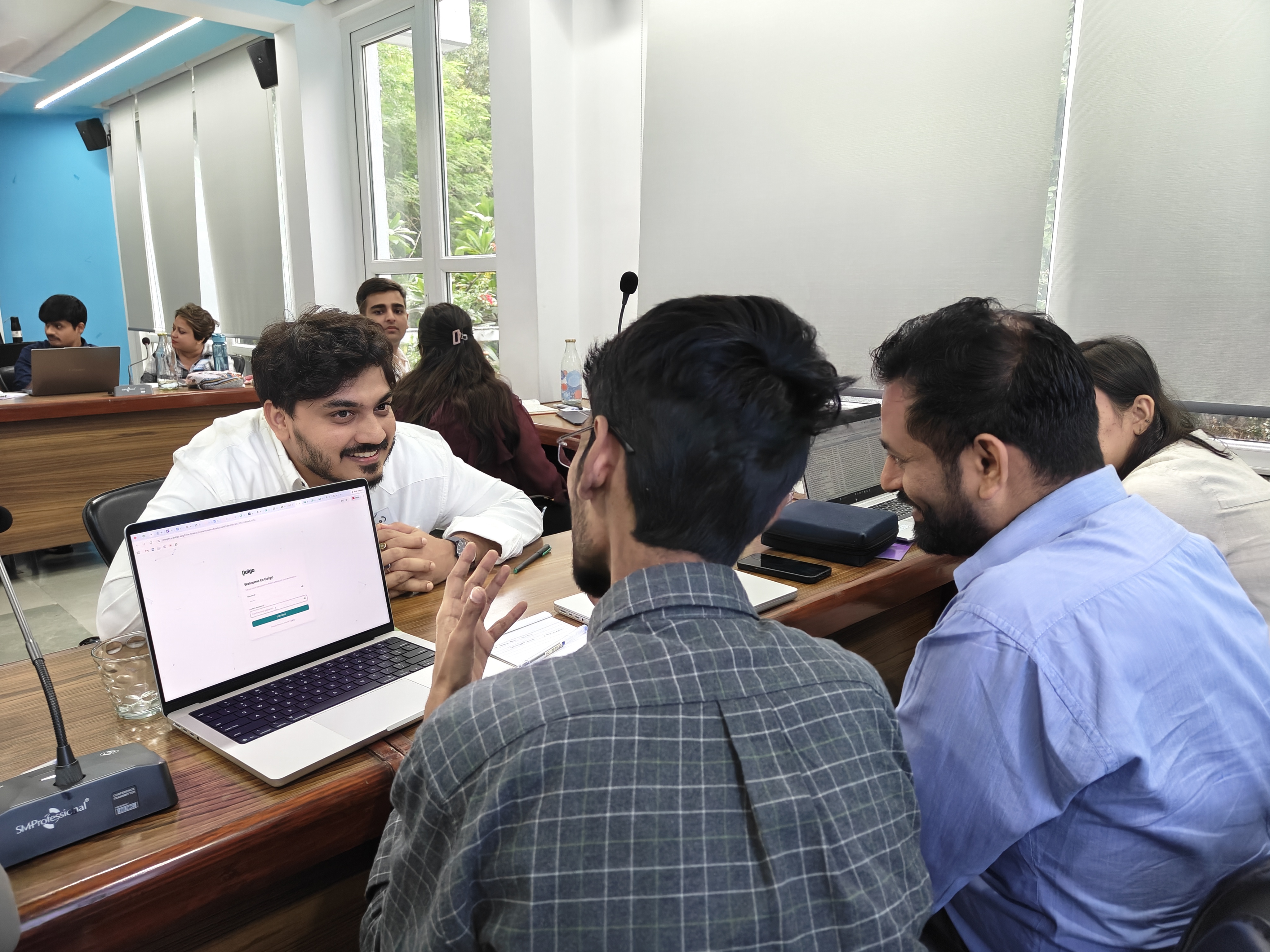
My work started with consulting and implementation, but gradually expanded into understanding operating models, strategy, business development, partnerships and growth. Along the way, I got to lead initiatives such as Data Decoded and Dalgo Bootcamps, facilitate webinars, and participate in events including Charcha, CSR Summits, Jal Chaupal, AI Summits, ISDM’s DoDM, ILSS events, Justicemakers’ Mela and several smaller, focused gatherings. Sometimes I was attending these events, sometimes organising or leading them, and sometimes sitting across the table from an organisation, trying to understand what it actually needed, align with my team and partners to deliver the right solutions, and meet the organisation where it was.
So this way I have had the opportunity to end up in rooms with NGO founders and CEOs, other CxOs, programme managers, CSR representatives, funders, M&E professionals, data teams, government functionaries, consultants, volunteers, researchers, implementation partners, vendors, and people working directly with communities. A few of those conversations were about technology. Most were about programmes, funds/money, growth, tech skills, ambiguous responsibilities at times, partnerships, reporting, and the quiet difficulty of making something work if failed for the first time. Then discussion on data surfaces on its own, usually uninvited. People often know more about their own domain than you know about yours. They may need less teaching than we assume and more curiosity, the right questions, and space to articulate what they already know. The starting point should be to learn and understand, not to assume we have something to share.
A conversation about growth turns up systems that stopped keeping pace two years ago. A question about visibility turns up information spread across six tools. A reporting requirement exposes two teams that have been defining the same indicator differently since nobody remembers when. The thing that arrives looking like a technology requirement is almost never a technology requirement.
I once asked a founder what he would have done about his data problem if we had never spoken. He thought about it for a second and said:
“Not really currently. We were living with what we have, to be very honest.”
That one has stayed with me. Not because it was resigned, but because it was precise. Nothing in his environment had ever made the problem urgent enough to act on, and nothing had made fixing it safe enough to try. The cost of the broken thing was spread thin across a whole team and invisible. The cost of fixing it would have landed on one person, in one quarter, with his name on it. People do not choose between a good system and a bad one. They choose between a known cost nobody blames them for and an unknown cost someone will.
That is the shape of most decisions I see now. Organisations do not make decisions. People inside them do, under conditions they did not choose. Priorities get set by who is responsible, what resources exist, how much influence that person carries, which relationships they depend on, and what they personally lose if it goes wrong. Sometimes a good idea dies because nobody saw the value. More often everyone saw it and nobody had the time, the authority, the confidence or the cover.
It shows up most clearly around technology. The real question is never whether to invest. It is how technology becomes part of how people work, instead of something reached for when a problem has already become impossible to ignore. Between knowing and doing sits a messier reality. People pick what feels familiar, what they understand, who they trust, what they think they can actually get done.
An organisation keeps an inefficient system because change feels risky, and it is, for one specific person. The migration has their name on it. If data comes across wrong during a reporting month, they are the one in that meeting. Someone decides not to ask for a technology investment because they are not sure the funder will approve it. One layer down: a rejected ask costs them credibility for the next one. Another layer down: they watched a colleague’s proposal come back with a note about overheads, and learned where the line sits without anyone ever drawing it.
A champion moves something forward, then leaves, and the knowledge and momentum leave with them. Not for lack of documentation. What mattered was never documentable. Who to call when the sync breaks. Why was the format built that way? Which funder cares about which number and which reporting style and on which platform. It matters who champions an idea, which teams gather around it, who holds authority, who uses data, and who decides without ever touching it. It matters what is loud that month. Compliance, a funder visit, monitoring, an internal deadline, or just getting the week out.
Understanding this sector means looking past what organisations say they need and past what their systems show. It means paying attention to what people know, value, fear, feel safe doing, and believe is possible. Some of it gets said. Most of it doesn’t. Thus this is not an attempt to revisit the familiar challenges of the social sector:- funding constraints, resource shortages, limited skills, capacity gaps, fragmented systems or the lack of technology. These are real, widely acknowledged and often discussed. What I am more interested in are the nuances that sit beneath them, and the realities that are not always as visible or openly talked about.
2. Understanding the Sector: One Ecosystem, Different People, Different Realities
2.1 The organisations and the ecosystem they operate in
The Indian social sector includes NGOs, non-profits, trusts, societies, Section 8 companies, foundations, social enterprises, community-based organisations, government bodies, CSR teams, funders, intermediaries, researchers, consultants, volunteers, technology providers and similar ecosystem actors. One word covering all of it, which is part of the problem. Even the vocabulary can mislead. “NGO” is not a legal form. Non-profits can earn revenue and run a surplus, as long as it goes back towards their purpose. Social enterprises run commercial models while pursuing social outcomes. Two organisations described identically can differ completely in legal structure, governance, income, operating model and scale.
We sort organisations by their primary themes: education, health, gender, livelihoods, agriculture, water, sanitation, environment, governance and so on. These categories are useful for proposals, reporting and ecosystem mapping. But nobody’s work sits entirely inside one theme. An education organisation may end up dealing with nutrition, gender, household income, device access and child protection. A water programme touches agriculture, environment, livelihoods and education. That is not the same as saying every organisation works across all these areas. There is a real difference between where an organisation focuses primarily and what its work keeps running into. Take menstrual hygiene, for instance. It is not just a health or gender issue; it is also connected to education, WASH, livelihoods and women’s agency. Awareness, access to affordable menstrual products, safe sanitation facilities and social acceptance all influence one another. Yet, organisations working on these aspects may operate in separate thematic areas, with different funders, programme designs and indicators, even though the realities they address are interconnected. And yet the category matters more than it looks. An organisation funded as an education organisation reports education numbers, so it collects education numbers. The nutrition problem its teachers keep flagging may never enter a dataset anywhere. The label quietly decides what is allowed to be true.
The ecosystem also holds institutions that never implement anything directly. Funders provide money. CSR departments work inside corporate structures. Intermediaries connect organisations to resources. Research institutions generate evidence. Consultants support strategy. Technology providers build and maintain systems. And communities are not sitting at the end of the chain receiving things. They shape the environment in which the work happens, and their involvement often determines whether it succeeds. Everyone here is working towards social outcomes. They arrive with different roles, expectations, resources and readings of the same problem. Worth remembering before assuming anyone has the same information, incentives or freedom to act as anyone else.
Note: Size and maturity vary just as much. A small community-based organisation can hold deep local knowledge and real trust, but have almost no institutional capacity. A mid-sized NGO can have established programme teams, several funders, and still run on spreadsheets. A large one can work across states with separate departments for finance, technology, M&E, communications and partnerships. None of that tells you how well an organisation works. Size is not maturity, and the people who understand a community best are usually the ones with the least time to build systems for it.
2.2 The people and institutions that enable and support the work
The social sector is not made up of organisations delivering programmes alone. There is a wider ecosystem of people and institutions that enable, support, connect, fund and strengthen their work. This includes institutional funders, philanthropic foundations, high-net-worth individuals, family offices, corporate foundations, CSR departments and individual philanthropists. It also includes intermediaries, volunteers, consultants, implementation partners, research institutions, government institutions, technology providers, other service providers and people working with or supporting non-profits in different capacities. These actors play different roles. Some provide financial resources. Others bring expertise, connect organisations to opportunities, support implementation, generate evidence, provide technology or offer specialised services that organisations may not have internally. Their responsibilities and relationships with non-profits vary. Some work closely with an organisation over several years; others come in for a specific project, assignment or requirement. Some are involved in strategic decisions, while others provide support that enables the organisation to carry out its day-to-day work.
Funders, philanthropists, CSR and institutional supporters: Who gives, why and what gets funded
Funding comes up first in almost every conversation, and it should. But the constraint is rarely whether money exists. It is the nature of it: how it is accessed, who can access it, what it may be spent on and how long it lasts. Institutional funders, philanthropic foundations, high-net-worth individuals, family offices, corporate foundations, CSR departments and individual philanthropists all play a role. Their reasons differ. Personal conviction, religious or family values, attachment to a cause. Foundations advancing a defined agenda. For eligible Indian corporates, CSR spending is a statutory obligation under Section 135 of the Companies Act, 2013, though the obligation only decides that they give, never what they give to. Discretion over causes, projects and organisations stays entirely theirs. Some are also building goodwill or contributing where they operate. Not everyone with capacity gives. Not everyone who gives consistently. Personal priorities, trust in the organisation and its leadership, preferred causes, perceived impact, and confidence in how funds will be used all influence the decision.
Funding availability is not determined by the existence of social need. It took me an embarrassingly long time to stop being surprised by that. Preferences vary across theme, geography, community, intervention and duration. Some fund institutional capacity; others want a defined project with measurable outputs. Some want direct outcomes, others want systems, institutions or innovation. Some want to contribute to a cause without the time or expertise to follow the operational detail of what they fund. Those preferences decide what gets funded and what organisations must demonstrate in return. Anyone providing money needs to know where it goes, whether it is used as intended, what was achieved and whether the organisation can be trusted. That is not bureaucracy. It is the minimum condition for giving money to strangers.
How that need expresses itself depends on who holds it. A corporate CSR team works through financial-year budgets, utilisation requirements, compliance, due diligence, documentation, internal approvals and several levels of review. An individual philanthropist operates personally, on trust. An institutional funder operates through formal applications, theories of change, reporting formats and defined cycles. So they ask for what those structures can absorb: people reached, activities delivered, grant utilised, programme on track. And the information they get back at times tell them very little about the actual work.
Funders are constrained too, supporting several organisations on limited resources. CSR teams juggle partners and approvals. Individuals may want to give more but cannot fund something indefinitely, creating at times a central tension: a funder may expect evidence of sustainable outcomes within three years, while addressing the underlying problem may take fifteen. The funder needs proof of progress, but the organisation also needs the flexibility to respond to realities that weren’t anticipated when the proposal was written. For instance, mobilising a community requires time, trust and an understanding of local context, even when the funding is structured around implementing a project with an already mobilised community.
Technology, data systems, software maintenance and organisational capacity often get filed as overhead rather than investment in effectiveness. So organisations learn to ask for what gets approved. Over time, that can mean hiring more people to do repetitive manual work instead of building the systems that would remove it. Such asymmetry is because a headcount line is legible. A programme officer can defend one more field coordinator to their own committee in a sentence, and the committee can picture the person. Data infrastructure takes a paragraph, and the paragraph invites questions the officer may not be equipped to answer. One level further: that officer is assessed on disbursement and visible outputs, not on whether their grantees became more efficient. Efficiency shows up in year three, under someone else’s name. This is not necessarily what the organisation believes is best. It is a response to signals received over years. Where an unsuccessful ask costs credibility for the next one, testing the boundary stops being worth it.
When I finally asked a founder directly how he would pay for a data system, he did not hesitate:
“Take out from the overheads. There is no specific funding project for this currently in pipeline.”
He was not complaining. He was describing arithmetic. He would be assembling the money from small slices of several grants, each of which was meant for something else, and he would be doing it quietly, because a line item called data systems would have invited scrutiny that a slightly larger administrative allocation would not. The most common funding route for organisational capability in this sector is one that nobody writes down anywhere.
None of this means funders are unwilling. Often the need is neither clearly understood nor well articulated. An organisation knows its teams lose days consolidating spreadsheets and re-entering the same information, and has nobody who can diagnose what would fix it, let alone build the case. And even where technology funding exists, a harder question follows. Can the organisation pick the right solution, assess vendors, manage implementation and keep it alive? Funding a system’s development is a different question from whether anyone can operate it three years later. Underneath all of it sits something psychological. A funder prefers a clearly defined technology project because it can be assessed, approved and reported on. It has a deliverable, a date, a photograph. Capability has none of those and cannot be shown to a board. Neither party is necessarily deciding what is best. Both are answering incentives they have already lived through. So the structure of funding decides what organisations prioritise, invest in and postpone, and eventually what institutional capacity they build. It shapes the programmes they run, the systems they build, the people they hire and the information they collect.
Beyond those providing financial resources, several other actors contribute to how non-profits function and deliver their work. Intermediaries connect organisations to resources, networks and opportunities. Consultants support strategy and organisational development. Research institutions generate evidence and contribute to understanding social issues. Volunteers bring time, skills and support to organisations. Implementation partners work alongside organisations to translate plans into action. Technology providers and other service providers bring specialised capabilities that organisations may not have internally.
These relationships can be short-term or long-term, formal or informal, and sometimes sit somewhere between service delivery and partnership. The support may be technical, operational, strategic or connected to a specific programme.
Government runs through the wider ecosystem, but it is not one stakeholder. It includes departments, district administrations, local bodies and frontline functionaries, each with different responsibilities, priorities and pressures. Plenty of initiatives depend on public systems, local institutions, schemes and administrative support. In practice, progress turns on who is holding a particular post. An official who sees the value makes collaboration easy. When an officer is transferred, the same initiative can lose momentum and have to start almost from scratch. This is not an individual failing; officers work within administrative processes, resource constraints and competing demands. A transfer can undo in a week a relationship that took two years to build.
I have seen organisations treat that as bad luck. It isn’t. It is a structural property of working with government, and the organisations that do it well build relationships at three levels deep so that one transfer does not erase them. That costs time nobody funds. Which also makes a case for collective advocacy. Several organisations on the same issue carry more weight together. Groups working on water conservation or desiltation may each hold evidence of need. Brought together and taken to government jointly, that evidence wins attention none of them would get alone. Here data is not reporting to a funder. It is building a shared case.
The people who lead organisations: Founders, CEOs, CXOs and leadership teams
Leadership titles vary and mislead. In one NGO the founder is the CEO. In another the founder sits on the board while a separate CEO runs operations. Some use Executive Director or Secretary General. Others have a President, CXO or Chief of Programmes, Chief Impact Officor. The title rarely tells you where authority actually sits. A board may set strategy while the executive team runs operations. Elsewhere the founder is on the board and still deep in operational calls. Even with a formal hierarchy, the person everyone checks with before moving is often not the person on the org chart. The contrast between small and large is sharpest here. In a small NGO the founder handles fundraising, programme management, recruitment, partnerships, operations, finance and reporting, and decides which funder to approach, which tool to adopt and which programme is in trouble. In a large one those responsibilities sit with different people, each with their own priorities.
Leadership turns a social problem into something someone else will fund. Explaining what, why, how, what it costs and what it will achieve. Not just writing a proposal. Understanding the work, building relationships, negotiating expectations and making commitments the organisation then has to meet. There is a particular pressure in being the one who tells the organisation’s story. Moving between the language of communities, the language of strategy and the language of funding, often in the same week, sometimes in the same meeting. This does not make leaders disconnected. Many are deeply involved. But as an organisation grows, their view of daily implementation depends on what reaches them through programme managers, M&E and finance. Which means their picture of their own organisation is assembled by people who each have reasons to present it a particular way.
I watched this happen in real time once. We had spent most of an hour with a community lead walking through her problems in detail. Formulas breaking, sheets to be updated, reports to rebuild. Later upon asking on historical data, the founder said:
“My major concern lies with how to align the last 7-8 years data to current data.”
Until now his team had been describing the current week’s pain, because it was what they lived with and what they thought we were there to fix. His worry was a decade of evidence he could not show a funder. Both were real. Neither would have surfaced the other, and if we had scoped that engagement from the operational conversation alone we would have built something correct and useless. Now I always ask the quiet person in the room last.
Leadership wants to know what is happening, whether programmes are on track, how funds are moving and where problems are forming. Getting that is rarely simple. Sometimes the information exists and cannot be brought together. Sometimes it exists in different formats and update cycles. Sometimes the founder asks three people because the organisation never built the process that would have answered it. Digital maturity is not institutional maturity – An organisation running on spreadsheets is not badly managed or unaware of its own work. An organisation with a sophisticated dashboard is not necessarily deciding anything better.
The flagship programme usually gets the systems and the attention. It is larger, more visible, tied to the funding relationship the organisation cannot afford to lose. Everything else runs on whatever was there before. Leadership may genuinely want consolidated information while the real constraint is priorities, ownership, coordination and whether anyone can maintain a system once it exists. Leaders are also balancing expectations that do not agree. Funders want reporting. Programme teams want flexibility. Finance is focused on utilisation. Technology teams want structure. Someone has to absorb the difference.
Resources are not only money. They are people with time, skills, authority and experience. I spoke to one organisation, fully committed to fixing its data, where the President was the only person who could speak to anything technical. Not the only technical lead. The only one. Everything about their timeline, their risk and what they could realistically maintain flowed from that single fact, and none of it would appear in a proposal. Small NGOs run fundraising, implementation, recruitment, operations, partnerships, finance and reporting through four or five people. Larger ones have the gaps between departments instead. So everything can depend on individuals. One person knows how a dataset is maintained, why a reporting format was built that way, and who to call when the sync fails. They leave and it goes with them. The documented process survives. The context that made it work does not, because writing the context down was nobody’s job, had no deadline, and appeared in no budget line. This is individual dependency and institutional memory: what happens when someone leaves and takes context, informal know-how or relationships with them. It is different from the question of who is responsible for a process while that person is still there.
A leader’s attention is finite, and what captures it is not always what matters most. It is what is loudest: what came up in the leadership meeting, what the board reviewed, what a funder asked about, what is on fire this week. A system that would save three hundred hours over three years competes with a programme problem that needs solving by Friday. The programme problem wins. It should, each individual time. Winning every single time is how organisations arrive at year ten with no infrastructure and no memory of having chosen that. So leadership’s job is not simply to receive information. It is to build the conditions where people can share it, understand it and act on it. That means ownership, collaboration across teams, and making sure nothing rests entirely on one enthusiastic person who might leave.
Then there is the coordination cost, which almost everyone underestimates, including me for a long time. Every new system, partner or reporting requirement adds communication, follow-ups, decisions and responsibility. An organisation can have access to a good technology partner and no bandwidth to manage the relationship (esp. when there is too much context switching is involved). A programme team can want better data and have no room to change how it works. Leadership can back something sincerely and never give it two consecutive weeks.
The people who implement the work: Programme, M&E, data and field teams
Once a commitment is made to a funder, somebody has to turn it into people, activities and delivery. Programme teams, M&E, operations, finance, field workers and implementation partners all become part of that process. The naming is inconsistent enough to hide what people actually do. Monitoring and Evaluation. MEL. MERL. Impact. Programme Quality. Research and Learning. Data. Analytics. MIS. Sometimes combined, sometimes scattered across departments.
Behind the labels the work differs. Programme teams sit close to delivery. M&E works on indicators, frameworks, evaluation and evidence. Data team (if there) handles databases, quality, integrations and dashboards. MIS keeps systems and operational reporting alive. In a small organisation one person does most of it. Field workers, community mobilisers, enumerators, teachers, health workers and frontline staff collect most of the information that eventually travels upward. In principle, programme teams understand implementation, M&E defines and analyses, and data teams build and maintain. The boundaries blur immediately.
Who is responsible when the data is wrong? Who changes an indicator? Who makes sure field teams follow the process? Who resolves a mismatch between the dashboard and the programme report? Usually everyone is involved and nobody owns it. This is the failure technology cannot touch, and the one it gets bought to solve. A system can make information available. It cannot create decision-making authority, and it cannot manufacture accountability where none was assigned. Organisations buy a tool hoping to fix an unassigned responsibility, then conclude the tool was bad.
The gap between what gets reported and what is known: Programme teams manage implementation while maintaining records, tracking activities, answering internal requests and preparing funder reports. They do this through staff shortages, weather, delayed procurement, community-level difficulties and shifting priorities. A programme team cares whether the intervention is reaching the right people and working. The reporting format asks for activities conducted, people reached, sessions completed and materials distributed. Those numbers matter. They are the record of what happened. They do not explain why it worked, why it didn’t, or what to change.
M&E professionals sit somewhere genuinely uncomfortable. They are accountable for evidence of performance while depending on information collected by other people through systems they do not control. They reconcile inconsistent definitions, late submissions, incomplete datasets and competing formats. They are expected to produce reliable evidence without the authority to change how collection happens. Responsibility without control is its own kind of professional strain, and I think we underrate how much of this sector runs on people absorbing it.
There is also a question about what counts as evidence. People reached, sessions run, households covered. Straightforward. Trust, dignity, confidence, agency, relationships, changes in how a community makes decisions. Central to the work, invisible to standard indicators. A programme can hit every target and miss its intent. It can also achieve something real that the agreed indicators cannot show. Not an argument against measurement. An argument for being deliberate about what we measure, what we leave out, and how we read the result. Reporting says what happened against an expectation. Learning asks why, and what should change. Organisations are pressed to do both on the resources for one.
I once sat with a community lead who looked after around 200 children. She explained her week to me like this:
“Whenever 5/10 children drop out, I have to remove the multiple sheets, and that is taking too much time. And whenever I delete the row and column, that impacted my formulas.”
She was not describing a software limitation. She was describing a system where the cost of a child leaving a programme is borne by the person who cared about that child most. Every dropout meant an afternoon of repair work. Over months, that quietly teaches someone to resent the record-keeping, and then to do it late, and then to do it approximately. The data quality problem that eventually reaches a dashboard usually began as a small act of self-protection by someone with too much to do.
Another organisation had 300 to 350 staff entering data into one application, then verifying it on paper every month, then re-entering parts of it into their accounting system. Three passes over the same facts. Nobody designed that. It accumulated, one reasonable requirement at a time, and by the time anyone noticed, each pass had a different person defending it. Think about what collection actually looks like. Long forms. Multiple formats. Shared devices. Unreliable connectivity. Language barriers. The same information entered twice because two funders want it differently, which happens not through carelessness but because each funder’s systems were built separately, and nobody in that chain is accountable for a field worker’s afternoon.
A form that looks simple from an office is a different object in a village, a school or standing in a field with one bar of signal. And they produce it without ever seeing what it becomes. Analysis happens elsewhere. Reports go to managers, leadership and funders. The person who collected it may never learn what it showed. Which also means the one person best placed to notice a number is wrong has no reason to look. This is why a feature-rich tool is often the wrong answer. An offline-first application, a local-language interface or a shorter form will beat a sophisticated platform. The last mile is not only connectivity. It is devices, language, gender, disability, social norms, field conditions and the actual capacity of the people expected to use it. Make implementation harder and the system degrades the quality of what it receives. It punishes itself.
Communities and the wider ecosystem
Communities get described as beneficiaries, target populations and end/service users. They are none of those things only. They have their own priorities and their own reading of the work happening around them. They are asked for information about households, income, health, education and livelihoods. How often are they told why it is being collected, who will see it, how it will be used, or whether it could affect the services they receive? Can they correct something recorded wrongly? Do they ever see what the findings were? (with new DPDP rules hopefully a lot of this will change)
Mostly no. And the reason is structural rather than unkind. Telling them is nobody’s job, no funder asks about it, and the whole accountability chain runs upward. Nothing in the system creates a reason to close the loop downward, so it stays open, permanently, and everybody involved can point at something else. So there is a real power imbalance. Organisations control collection, storage, analysis and sharing. Communities have almost no visibility into any of it. And data makes some realities visible while leaving others out. If something is not measured, it does not appear in a report or influence a funding decision. If the system cannot capture people’s experience in their own terms, it represents a fraction of what is true.
We should be careful not to confuse the data system with the reality it is supposed to describe. Education, health, nutrition, livelihoods, gender, environment and household conditions all move each other. Funding structures, programme designs, indicators and datasets cut them into separate categories anyway. Organisations working on connected issues hold information the others could use, and it stays disconnected. Government systems, NGO records, community observations, public datasets: each holds a piece of the same problem. They rarely meet. So the opportunity is usually not to collect more or build another application. It is to connect what already exists and build a shared reading of the problem.
Two examples of how connected this actually is:
- Water conservation and ecological restoration: The condition of a water body is not explained by water availability alone. It connects to the watershed, soil, rainfall, groundwater, land use, agricultural practice and the livelihoods of families dependent on that ecosystem. Water shapes soil. Soil shapes crops. Crops shape livelihoods. And the resilience of farming families shapes how the resource gets used in the first place. The information sits in different places. A programme holds records of water bodies restored and people reached. Field teams hold observations about local conditions. Environmental and geospatial datasets hold rainfall, groundwater and land use. Public datasets hold socioeconomic information. None of it is connected. The opportunity is usually not another application or replacing tools that work. It is connecting what exists and letting people see how the pieces relate. Though bringing datasets together does not establish causation. Definitions, quality, time periods and context still decide what you can honestly claim.
- Education: A foundation have worked with offline applications, gamification, activity-based learning kits, teacher training, government partnerships and deliberately frugal solutions. A programme can track schools reached, teachers trained, kits distributed, app usage and quiz scores. Useful indicators, none of which tells you whether children are learning. Learning depends on the teacher, the classroom, the child’s foundational level, attendance, language, household conditions and what support exists at school. A child may have the app and never open it. A teacher may have the training and lack the backing to use it. A school may have the materials sitting in a cupboard. The teacher remains the thing the whole intervention rests on, and the teacher is the one variable no dashboard captures.
Which is why adoption and ownership matter more than deployment. A solution arriving in a school is not the same as it becoming part of how that school works. All of this compounds. Funding decides who an organisation can hire. People decide what gets built. What gets built decides what information exists when a decision is being made. And those decisions decide what actually reaches communities.
3. Data, Technology and AI: What Sits Beneath the Surface
Information moves between funders, NGOs, programme teams, M&E, field workers, government and communities. Somewhere in that movement it gets collected, stored, processed, shared and interpreted. The gap is not between organisations and data. It is between the information they already generate and any ability to use it. That is where technology walks in.
What the technology landscape actually looks like : Google Forms and Sheets, Excel, KoboToolbox, ODK, Salesforce, Airtable, HubSpot, Supabase, Frappe, Tally, SurveyCTO, custom applications. For reporting, Power BI, Looker Studio and Superset. I counted, at one point. Across 120+ conversations from mid-July onwards, spreadsheets came up 45 times, Salesforce 20, KoboToolbox 8. That is my own pipeline, not a survey. It shows still spreadsheets as being used largely. Not as a stepping stone to something better. As the system of record.
Of those early days’ scoping call taught me more than those numbers did. We had spent twenty five minutes planning how to merge an organisation’s historical CSVs with its live system when the person on the other side said:
“But the CSV what I have is a download from Salesforce itself.”
We had been designing a solution to a problem that did not exist, confidently, for twenty minutes. Nobody had lied. We had just never asked where the file came from. Most bad scoping I have seen is not a failure of listening. It is a failure to ask the dull question about provenance before the interesting question about architecture. These systems mostly serve different purposes, and serve them fine. A specialised case-management application may be doing exactly what it should. Replacing it to achieve one consolidated system is usually the wrong instinct. The better question is how information from systems that already work can be connected, shaped into consistent structures and made available. This is the plumbing nobody notices: connecting sources, maintaining quality, preserving context and managing access.
The difficulty runs through the whole lifecycle:
- Collection. Who collects it, how, and for whose purpose?
- Quality. Are definitions, formats and processes the same across teams?
- Fragmentation. Where does it live, and how many disconnected systems exist?
- Integration. Can sources be brought together and read in context?
- Ownership and access. Who is responsible, who can see it, and who can change it?
A community lead once described her problem to me better than any framework has:
“All data are looking important, but we are not able to find what is the actual important data.”
She was not short of data. She was short of a way to rank it. And nobody in her organisation had the standing to declare some of it unimportant, because every field on that form had been requested by somebody with more authority than her. Data bloat is rarely an analytical failure. It is an accumulation of unrefused requests.
Worth separating three things. Data is records. Information is records organised so they mean something. Institutional intelligence is information read in context and acted on. A dashboard delivers information. Whether anyone builds intelligence out of it depends on whether people understand what they are looking at, argue with it, and do something. And a single source of truth does not have to be one system holding everything. Clear authoritative sources, agreed definitions, named owners, update cycles and systems that can talk to each other will do.
The build-versus-buy argument runs inside most organisations with a technology team, and building has real appeal. Your own people understand the organisation. Coordination is easier. Nobody waits on a vendor. Sometimes it is right, particularly when the requirement is genuinely unusual. But building software is not building version one. It is recruiting and keeping people, gathering requirements, testing, absorbing feedback, maintaining integrations, handling security and shipping changes forever. Meanwhile, mature, tested, supported alternatives already exist.
I have also watched an in-house build fail and poison everything after it. One organisation’s board had funded an internal platform that never worked. Years later they were sceptical of every external tool, and nervous about data leaving their walls. The failed project had not just wasted money. It had taught the board a lesson about technology in general, and that lesson was now applied to proposals that had nothing to do with it. Common needs (solved problems) like collection, storage, reporting and analytics rarely require everyone to build their own version.
Technology partners usually arrive when someone wants better reporting, automation or visibility. From outside, the opportunity looks obvious. Information scattered, reporting slow, leadership flying blind. The real problem is usually elsewhere. A dashboard will not fix indicator definitions nobody agreed on. An integration will not settle which system is authoritative. Automation will only make a bad approval process happen faster. And an external partner is not automatically lighter. It adds coordination, context-sharing, follow-ups and decisions to teams already stretched. Managing the implementation can become the burden. A hybrid usually works better. The organisation keeps ownership of its data, processes and decisions, and uses partners where they genuinely add something.
AI is already in use across communication, translation, analytics, agriculture, education, healthcare and programme monitoring. Conversational tools supporting families, voice chatbots in local dialects, agricultural advisories, computer vision, WhatsApp learning. But it brings us straight back to data and readiness. AI depends on what it is given. Incomplete or poorly understood data produces output that is confidently wrong, and fluency makes that harder to catch, not easier. There is also the risk of reproducing bias. Less representation of a community in the data can mean less service to that community. The distinction that matters is assistant versus decision-maker. In healthcare, children’s services or eligibility for support, there has to be accountability, human oversight and a route for someone to challenge what was decided about them. Adoption needs more than access to a model: data, infrastructure, skills, funding, capacity to maintain it, and clarity about what happens if the vendor disappears.
AI changes how we use data. It does not remove the need to understand the people and contexts behind it.
4. What Happens as Information Moves Through the Ecosystem
What holds this ecosystem together is not money, programmes or technology alone. It is the information passing between people, the expectations attached to it, and the relationships deciding how it moves.
The same information, different meanings: Follow information about a child or a household. A field worker collects it. It goes into a form, then a spreadsheet, is reviewed by a programme manager, analysed by M&E, presented to leadership, shared with a funder, and eventually touched by a technology provider. At every step it is interpreted differently, reformatted and used for something else. The same number is accountability to a funder, programme progress to leadership, another reporting task to a manager, and one more form to a field worker. A delay is poor performance to one person and an unavoidable reality to another. A request for more information is due diligence to one and additional burden to the next. Which is why data quality is not simply whether a number is correct. It is whether the information was collected for the right purpose, whether its context survived the journey, whether it was read appropriately, and whether anyone is using it responsibly.
Once information starts moving between people and organisations, questions of access, purpose, responsibility and protection become difficult to avoid. Concerns around personal data came up far more as the year went on. The act and its rules that followed make this concrete. The work is less about having a privacy policy than about how data is actually handled:
- What personal data is collected, and for what purpose?
- Which systems store it, and where?
- Who has access, and who is it shared with?
- How long is it retained, and when is it deleted?
- Are people given proper notice and a real consent mechanism?
- Are there additional safeguards for children’s data?
Practical steps exist. Stop collecting what is not needed. Keep personal identifiers out of analytical datasets. Hash or anonymise. Use role-based access. A privacy policy does not mean responsible practice. The processes, permissions and behaviour of the people handling data decide that. Information collected from communities is not a resource an organisation owns because it happens to hold it. It was entrusted, and that carries obligations.
There is also an economic dimension to all this. Organisations evaluate technology on the visible cost: the platform, the subscription, the implementation. The cost of continuing without it appears nowhere. I watched this play out in a pricing conversation once. We had explained that the organisation would need its own data warehouse, which would be modest and theirs to own. The person across from me said:
“It’s going to add to my cost is what I sincerely feel.”
He was right, and he was also missing it, and both things mattered. He could see the new line item precisely because it was new. He could not see the cost already running through his organisation, because that cost was distributed across a dozen people’s weeks and had never been written down anywhere. Nobody budgets for the thing they already pay for. This is why the manual process survives: it is expensive and invisible, which is the perfect combination for lasting forever.
Think about time spent combining spreadsheets, reconciling versions of the same report, entering information twice, chasing missing data, rebuilding the same analysis in four funder formats. That comes out of programme, M&E and leadership time. There is an opportunity cost every time a decision waits because the information is unreadable. But investing is not free either. People are needed to manage systems, train teams, maintain processes and coordinate with vendors. The visible cost is the subscription. The real cost includes training, support, recruitment, coordination, maintenance and the institutional knowledge to keep it alive. Hardest for small organisations with no data team.
So the question is not whether an organisation can afford technology. It is whether it can afford what it is already paying to do things manually, and whether it can sustain something better. Sometimes a spreadsheet is genuinely enough. The question of cost also leads to a larger one: what happens when the funding, project or external support that made something possible comes to an end? Most programmes run inside defined funding periods, often three years, and funders reasonably want evidence the work can continue. But outcomes rarely depend on one organisation or one intervention.
Take child literacy. Materials, teacher training and learning sessions matter. So does whether the child has a safe home, enough food, a quiet place, a device, family income that lets them stay in school rather than work, language support, and someone who takes an interest. Those conditions move together. One organisation works on foundational learning, another on nutrition, another on household livelihoods, another on child protection. No single organisation is expected to solve all of it. But it needs to understand how the pieces interact and where convergence is necessary.
Sustainability is not a milestone to hit before a grant closes. It is strengthening people, institutions, systems and relationships so the work has a chance of continuing.
The same applies to technology. A system was implemented, a dashboard built, a programme closed. Who maintains the data? Who pays for the tool? Does the organisation still have the people to use it ? Deployment keeps getting mistaken for success because the grant milestone was system delivered, and delivery is verifiable inside twelve months while adoption takes eighteen. Everyone in the chain is measured on the thing that can be measured in time. A system nobody uses is not an asset. It is another responsibility. A good implementation should leave an organisation more capable and more independent, not permanently dependent on whoever built it. Scale deserves the same skepticism. Replicating a programme across 100 locations is not achieving outcomes in 100 contexts. What works in one place may need rebuilding in another.
Trust, expectations and what gets left unsaid: Across funding, implementation, data protection and sustainability, one thing keeps surfacing: trust. The funder and NGO relationship runs on it. So does the one between leadership and programme teams. Communities have to trust the organisations collecting their information. NGOs have to trust technology partners. Teams have to trust the systems they are told to use. And nonprofits will forgive you a great deal. A missed deadline. A deliverable that slips three weeks. An invoice in the wrong format, a call moved twice, if you do not know the answer to a query immediately over a call. All the professionalism clauses a commercial client would escalate on are, here, largely survivable. People will give you the room, often more room than you deserve.
What they do not forget is the sense that you were not straight with them. Oversell a capability once, go quiet when something breaks, handle their beneficiary data carelessly, and the relationship does not get renegotiated. It ends. Usually without anyone telling you why, and in a sector small enough that the conversation about you continues in rooms you will never be in.
When an organisation hands you their data they are handing over something they hold in trust from somebody else, a community that answered questions it did not have to answer, a funder who released money on a promise. A breach by you is not yours to absorb. It is theirs to carry upward and downward, to a board, to a donor, to a village. And the person who brought you in has already staked their own standing on that choice internally. Letting them down is not an institutional event. It lands on one named individual who argued for you in a meeting you never saw.
So everything here starts from trust, and once it is there, almost anything becomes possible. Scope shifts without a fight. Introductions you did not ask for. Work that carries on while the paperwork catches up. Elsewhere you earn the next contract. In this sector you earn the benefit of the doubt, which is worth far more and takes far longer to win back. Trust is not built through good intentions. It is damaged by unreliable information, deliberate miss/partial communication, weak data protection, unclear expectations and systems that do not match what is happening on the ground.
It is also worth not romanticising any of this. People in NGOs, funders, CSR teams and technology organisations have careers, financial obligations, ambitions and institutional pressure. They are trying to do meaningful work inside institutions with their own incentives. So it matters to ask not just what someone needs, but what is shaping the need. Sometimes people say these constraints out loud. Often they don’t.
25-30 minutes into a scoping call that had been going well, after we had walked through the problem and sketched an approach, (already asked before of alters ate options if they have been exploring which they said no) someone mentioned almost in passing:
“We had also explored Tableau on the side.”
They had been running a parallel evaluation for weeks a couple of months ago. Nothing dishonest had happened. They simply had no reason to volunteer it, and probably a few reasons not to. I think about that call often, because the most useful thing in the conversation arrived by accident, late, and only because the room had become comfortable enough for it. Most of what you need to know in this sector is like that. It is not hidden. It is just not asked for (sometimes so explicitly).
Information gets shaped to meet the expectations of whoever receives it. Uncomfortable details get left out, rarely to mislead, usually because nobody is certain how it will land or what it will cost them. An organisation that once watched a funder react badly to an honest problem learns to report differently, permanently. Not everything left unsaid is deliberately withheld. Sometimes people do not have the information, authority, time or confidence to communicate it. Sometimes the system has never created space for their perspective in the first place. Understanding that is not assuming bad faith. It is recognising that people decide inside the situations they are in, the incentives they face and the risks they can see.
5. What I’m clear about, and what I’m still figuring out
There is no single description of this sector’s data landscape. It is too varied, and it shifts across organisations, teams, themes, geographies and funding models. But some things have got clearer.
- Data problems are organisational problems first: Unclear responsibilities, fragmented processes, thin capacity, mismatched expectations. The technology problem is often the last layer, and the easiest one to buy a solution for.
- The same information means different things to different people: A reporting requirement to one person is an operational burden to another. A simple dashboard request is usually a question about visibility or accountability wearing a technical mask/dress.
- More data is not more understanding: What decides it is whether information is reliable, relevant, accessible and read in context.
- The people closest to the work should not be sources of data rather much beyond that.
- Technology can connect parts of this: It cannot replace the relationships, institutional understanding and trust holding it together.
I came into this wanting to know how technology could support development organisations. I have ended up more interested in the people, processes, field realities and relationships that make those organisations work at all. That may be the more useful place to start. So instead of asking only what data an organisation has, what tools it uses or what dashboard it wants, I find myself asking a different set of questions:
Who are the people involved, and what are they trying to achieve? Who are they working for, and whose needs are they trying to meet? What responsibilities, expectations, incentives, relationships and constraints shape their decisions? What organisational, institutional and social realities are they operating within? What do they feel able to say, what remains unspoken, and whose perspectives are being heard or left out? How does all of this shape what information gets collected, how it is interpreted, what’s already in-use, what gets shared, what decisions are made, and ultimately what reaches the people and communities the work is meant to serve?
Because the reality of this sector does not sit in any one organisation, dataset, dashboard or report. It sits in the space between what is intended, what is possible, what gets implemented, what is recorded, what is reported, what is understood and what is actually experienced. And to understand that reality, we have to look beyond the systems themselves and pay attention to the many people and relationships behind them!