Most of the AI conversations I hear in the nonprofit sector are about programmes. Chatbots for farmers, tutors for children, triage tools for health workers. That work matters, and others are doing it well.
This post is about something less exciting. It is about the work that happens in the office: the proposal due on Friday, the donor report in a new format, the expense bills waiting to be checked, the CRM nobody has updated since last month.
In October, Dhwani RIS and 10x Impact Labs, with support from Project Tech4Dev, opened applications for a small cohort called AI for Nonprofit Operations. Six nonprofits will each take one back-office task and put AI to work on it, properly, until it is part of how they run. Before we start, I want to write down why we pitched this and what we believed going in. Most of it comes from things we tried on ourselves first.
It started with our own sales pipeline
Around March or April this year, I sat down with the proposals our team was sending out and how we were tracking them. I didn’t like what I saw.
We were writing eight to ten proposals and RFP responses a month. Our CRM was rarely up to date. We were finding opportunities late, and some we never found at all. Even when someone had spotted an RFP, the eligibility criteria hadn’t always been read carefully, or the deadline wasn’t tracked. Three people shared the pipeline. A lot of the information lived in WhatsApp messages and email threads and never made it into the CRM. And I understood why. Typing the same details into one more system is data entry, and nobody joins a tech company to do data entry.
People were working hard. There were just too many small manual steps, and each one was easy to miss.
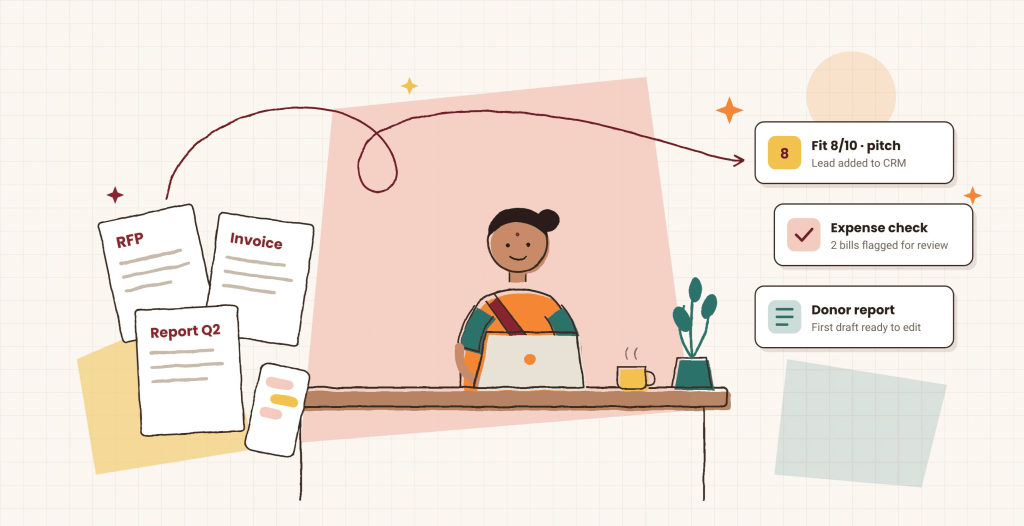
I’m not a developer. But I wanted to see whether I could build an RFP scout that did the first pass for us. I gave Claude the context it needed: what Dhwani offers, who we’ve worked with, our basic compliance documents. The scout now goes through a set of sources every day. For each opportunity it reads the eligibility criteria, checks whether we actually qualify, scores the fit from 1 to 10, suggests which of our offerings fits, and recommends whether to pitch. The ones worth pursuing go straight into our CRM, Zoho Bigin, as leads. Later I extended it beyond India to South-East Asia.
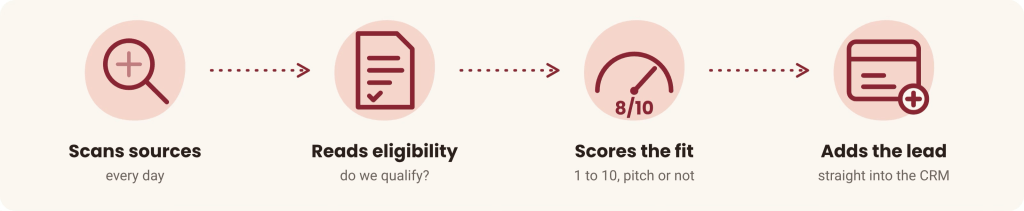
How our RFP scout works.
We then connected the same setup to our email. When someone writes to us about a possible engagement, Claude reads the email and updates the lead in the CRM. Whether a lead comes from the scout or from an inbox, it ends up in one place without anyone retyping it. A small plugin also helps us with the first draft of a proposal, which a person then reworks.
| 8–10 proposals a month, before | 15–20 proposals a month, after the RFP scout |
The CRM is current. We find opportunities earlier, and fewer slip through because a deadline sat in someone’s WhatsApp. We still decide whether to bid and what to write. The scout takes away the reading, sorting and retyping that used to come before those decisions.
Then our communications
The second thing happened in September and October, when I started looking at our communications. The material going out from Dhwani wasn’t great. It was inconsistent, it didn’t look good, and we weren’t trying many formats.
I built a few skills and plugins in Claude to make our content more standard and more visually appealing. We looked at what others in the market were doing and borrowed ideas. The bigger shift was being able to take one piece of content and turn it into several: a LinkedIn article, an HTML newsletter for our mailing list, a short video. Things that would have needed a designer, a writer and a video editor now start as one draft that a person shapes and approves.
I now use this every week for our social media. It made us more willing to experiment, and the storytelling got sharper.
Between the RFP scout and the content work, I had two working examples inside our own office. Both were back-office functions. Neither was glamorous. Both changed how much the same small team could get done.
From our office to theirs
The obvious next question was whether this was a Dhwani problem or a sector problem.
We have a useful window into that. Our grant management platform, mGrant, is used by around 50 funders to manage their grants, and roughly 1,000 nonprofits report to those funders through it. All through the year we see these nonprofits submit monthly project reports, quarterly progress reports, fund utilisation reports, annual reports, impact stories, narrative reports and field visit reports. Most of them report to several funders, each with its own format, its own deadlines and its own questions. A lot of skilled programme and finance time goes into reassembling the same information again and again.
That made me look at the whole back office, not just fundraising. In a nonprofit, the RFP scout is only one small part of fundraising. HR covers recruitment as well as everyday people operations. Finance means reading bills, checking expense claims against policy and validating supporting documents before anything is approved. Donor reporting cuts across all of them.
So we wrote down a hypothesis:
OUR HYPOTHESIS
A large share of the effort in running a nonprofit sits in repetitive, document-heavy, rule-based work. AI can take on much of the reading, checking, matching and first drafting. People stay responsible for the exceptions and the decisions.
The question: can AI materially reduce the administrative effort and cost of running a nonprofit?
We were clear from the start that we didn’t want to run another AI training programme. Tech4Dev and others already run good ones. We wanted each organisation to leave with one real task working differently.
Shaping it with Tech4Dev and 10x
In July, Project Tech4Dev invited partners in its capacity-building network to propose cohorts. It was good timing. We paired up with 10x Impact Labs because they are strong where we are not: understanding how an organisation actually works, redesigning the process, and helping people adopt something new. Dhwani brings the technical side, from deciding what to build to connecting it with the systems an NGO already uses.
Our first proposal in August was for five large nonprofits, with budgets of ₹25 crore and above. We didn’t ask the participating nonprofits to pay a fixed fee. Tech4Dev shortlisted it and then pushed us, along with the other shortlisted teams, on a few points:
- NGOs should pay a real share, because paying creates ownership.
- No NGO should have to buy any partner’s product to take part.
- The cohort should leave capacity behind, not dependency.
- It should be something we would run again with new NGOs, because the sector needs it, not because a grant exists.
Those questions changed the design more than anything we wrote ourselves. Over the next few weeks we moved to six NGOs. Each nonprofit now pays ₹3 lakh, which is half the cost of its place in the cohort. Tech4Dev’s grant covers the other half. We added time to document what each NGO learns, so the next cohort starts ahead. And when we sat down to plan the outreach, we lowered the bar to organisations with budgets of ₹5 crore or more, because the problem clearly wasn’t limited to the largest nonprofits.
The rules we set ourselves
A few principles came straight out of our own experience.
| One task, all the way. Each NGO picks one task, maps how it is done today and how long it takes, and takes it into daily use. A small change that sticks teaches more than a big plan that doesn’t. |
| AI prepares, people decide. AI can read, extract, compare, summarise and flag. People approve, reject and decide. It may flag an expense against policy, but the finance head decides. It may rank an RFP, but leadership makes the call. That is how our own RFP scout works, and it is why we trust it. |
| Work with what they already have. No new software is built. We connect the systems an NGO already uses, whether that’s Tally, Zoho, Google Workspace or Microsoft, to an AI tool, and keep it simple enough that they can run it after we leave. |
| The people who do the work, do the work. Each NGO puts in a department head, from finance, HR, fundraising or admin, for a few hours a week. Their CEO or ED joins three check-ins to choose the task and decide whether to keep it. |
| Measure before and after. We look at how long the task takes, how often it goes wrong, and how long people wait for it. Each team also writes down what it will cost every month to keep running, so leaders can decide with real numbers. |
| Stopping is a valid result. If something doesn’t work, or costs more than it saves, we stop and write down why. We would rather an organisation learns that cheaply than keeps paying for something that doesn’t help. |
What happened when we opened applications
| ~40 applications so far | 6 seats in the first cohort |
Close to 40 applications for six seats told us the problem is real. A few other things surprised us.
Small organisations asked the hardest. A large share of applicants are below the ₹5 crore line we drew. Their applications were also the longest and most specific. One small organisation working with tribal communities in Maharashtra listed proposal writing, donor communication, report preparation, compliance tracking and beneficiary data, all in one breath. Another wanted help translating documents and tracking government schemes. In these organisations, one or two people do all of it, and they feel the weight more than anyone.
The person who applies is often not the decision-maker. In small NGOs it was the founder or president. In larger ones, it was often the M&E manager, the communications lead or the partnerships person. The people who do the repetitive work are not always the people who hold the budget. That is worth remembering when we talk about adoption.
What they want help with. Proposals and donor reports came up more than anything else. Then finance and accounts. Then communications: social media, case stories, newsletters, which is close to what we did for ourselves. A few asked for help with all of it.
The line between back office and programme is blurrier than we thought. Several applicants asked about tracking student placements, following up on retention, or handling field data and photos. On paper, those are programme tasks. To the person doing them, they are the same kind of reading, matching, retyping and reporting. It suggests the method could travel further than the back office.
What we don’t know yet
We start with the first six organisations soon, and there is a lot we will only learn by doing.
Will the new way of working survive once we step back? Too many technology projects in our sector look good at the demo and quietly fade six months later. That is why we schedule check-ins after the cohort ends, and why each NGO decides, with real costs in front of it, whether to keep going.
Can small organisations afford it? The cohort fee and the monthly running costs are manageable for a ₹50 crore NGO. They are a real stretch for a ₹2 crore one, and those are the organisations that asked us loudest.
Can this work with fifteen organisations instead of six, without losing the attention each one needs?
We don’t have answers yet. What we do have is a method we have tested on ourselves, a design that Tech4Dev’s questions made much stronger, and far more organisations asking for this than we can take in one round. We will share what the first cohort learns, including what didn’t work, so that whoever runs the next one starts further ahead.
AI for Nonprofit Operations is run by Dhwani RIS and 10x Impact Labs, with support from Project Tech4Dev.
Written by Sunandan Madan, Co-founder, Dhwani RIS