
I still remember when I started coding six years ago. It began with a simple “hello world,” and not long after, I built my first small project. I can’t even remember exactly what it did anymore, but I clearly remember the feeling when it finally worked. Oh god, I was so happy. I have always loved building things: finding small problems around me and trying to solve them. That’s why I wanted to go into software engineering. Somewhere along the way, I also found myself drawn to the social sector. Part of it was personal – I wanted my work to actually mean something, to feel like it was adding a little good to the world, and the social sector gave me that. So, for the love of building things and the social sector, I joined Project Tech4Dev.
If I look at the last two years, I have seen a 180-degree shift in how we build products and in the whole engineering process. And I won’t lie as a junior engineer, it is intimidating. Almost demotivating. Because now you watch AI do your work while you just sit in front of your laptop pressing enter. I kept asking myself, “Where did the joy of coding go?”
But then, cut to six months ago. At the Neembaadi sprint, we had a makers’ day at Glific where I was prototyping text-to-flow. I sat down in front of my laptop and thought about how I should go about it. I sketched a quick flow diagram in my notebook, spent some time thinking through what to use and when, and once I had a solution in my head, I started coding it. I used Claude, obviously. And when my prototype was ready and actually working, I demoed it to people, and I could see how excited some of them were. That’s when it clicked – the joy of coding was back. But this time it felt a little different. This time it was a mix of joys – the joy of planning, designing, and implementing; the joy of making something easier for NGOs; the joy of knowing that this makes sense.
What I didn’t see coming was that the next six months would put me on both sides of the table at once – getting mentored on some projects, and becoming a mentor on others.
The getting-mentored part began with the AI Cohort. The idea was to start with AskGlific, a support tool inside the platform, and then slowly move toward task completion and text-to-flow as well. The cohort had seven NGOs, each with their own interesting use cases, which was so refreshing to see. What struck me was that all of these NGOs are already doing amazing work and already helping thousands of people, and here they were with a new use case, knowing that once they cracked it, they would become so much more efficient and reach even more people.
Through the AI Cohort, I worked on AskGlific with just one thought in my mind: what would make this easier for the people using Glific? What would they want? Is this actually helpful? That question kept me going, and I enjoyed building it so much. I hit plenty of failures along the way. The response quality was bad, the bot was hallucinating, sometimes answering the complete opposite of what was asked. That was demotivating too. But there I was again, with pen and paper, scribbling how can I build this? What can I do better? And eventually, after a lot of experimenting and a lot of proposed changes, with my mentors Rajsekar and Vinay listening to every one of my ideas and pushing me on what more I could try, it started to work. The same bot that used to hallucinate and answer the complete opposite was now answering Discord questions properly, debugging real issues, and holding steady at 65–70% accuracy. That number might sound modest, but getting there meant rethinking the whole approach more times than I can count, and watching it finally hold up felt like a genuine milestone. The joy I felt that day was a new kind altogether the relief of something hard-won finally clicking, and the quiet satisfaction of knowing I’d built something people would actually use.
The cohort story didn’t end with the build, though. Last week, I went to its closing, where I demoed AskGlific in front of everyone. I was scared, but I did it anyway, and I thoroughly enjoyed it. I had so much help from Akhilesh, Lobo, and Jerome, who gave me feedback and a pep talk beforehand because they could tell I was nervous. I also got to watch the other organizations present, and sitting in that room while one team after another walked through what they’d built, every solution different, every one solving a real problem, was honestly one of my favourite parts of the whole thing.
The mentoring part began with the AI Accelerator. While the cohort was running, Glific also kicked off an AI Accelerator with 34 NGOs in April, every single one of them with incredible AI use cases. I was assigned to mentor two organizations I’d worked with before: MukkaMaar, a Mumbai-based NGO that runs self-defence programs for adolescent girls in government schools, and the India Literacy Project (ILP), which has spent decades working at the grassroots to get children into school and help them keep learning. Each came into the accelerator wanting to use AI to reach more of the people they already serve.
Because I’d worked with both before, I knew about their programs. As prep for the two-day workshop, I went through their use-case documents and their goals, and I caught myself sketching possible flows in the margins before we’d even met. I sat down with both NGOs beforehand and we decided what to work on for the accelerator. Once the use cases were locked in, we met in Bangalore, had some more discussions, and by the end of the very first day, both teams had a working prototype! How exciting is that? There comes that joy again. I could see Shraddha from MukkaMaar, and Suriyan and Shweta from ILP, genuinely happy with what they had built and so motivated to keep going. Just this month, ILP wrapped up their first pilot with 90+ people across different states, and MukkaMaar completed theirs with 24 fellows.
When I look back at these six months, I realize I had been both a mentor and a mentee at the same time, and it helped me more than I can say. I started noticing the overlaps: when my mentors taught me something that I could see being useful for my NGOs, I’d share it with them. And I took learnings from my NGOs’ implementations and pilots and applied them to my own work. It was a full circle, and I loved every part of it.
And the learning didn’t stop there. After the AI Cohort, I stayed back with the Kaapi team, along with Siddhant and Ishan from the Dalgo team, and we ran a mini AI sprint. Siddhant became my mini-mentor, and together we built Sentry autofix, an AppSignal monitoring and autofix layer, and an MCP for Glific, which is going to be so exciting as we start implementing Phase 2 of Ask Glific. Thanks to Siddhant for helping me pull this off.
So, about that joy I thought I’d lost? I don’t think I miss it anymore, because I’ve redefined it.
These days, the part I love most happens before I write a single line of code. I spend more time sitting with the problem itself: who is this for, what do they actually need, what would genuinely make their work easier, and does the thing I’m about to build even make sense for them? Then comes the planning: breaking the problem down, mapping out how the different pieces will fit together, deciding what to build first and what can wait. A lot of that still happens on pen and paper, exactly like it did on that makers’ day. I find myself thinking much more about the design of the system as a whole: how the parts talk to each other, where it might break, what happens at the edges, and how it’ll hold up as it grows. The actual coding has become the last step, the part that happens after all the thinking is done.

Text-2-Flow
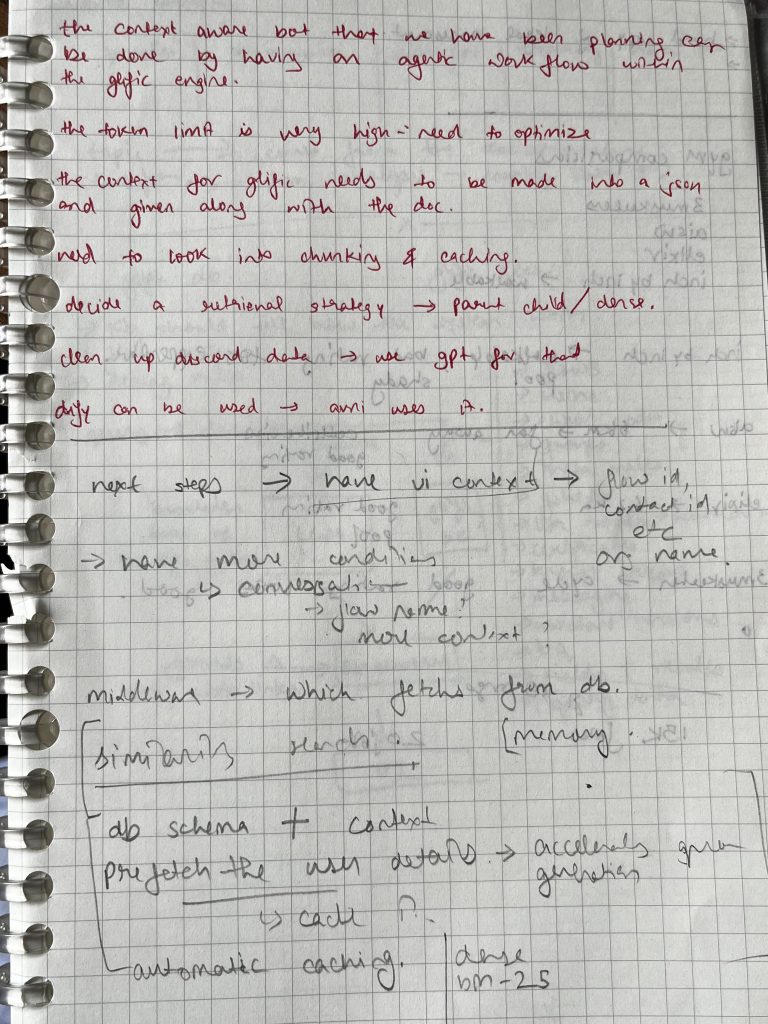
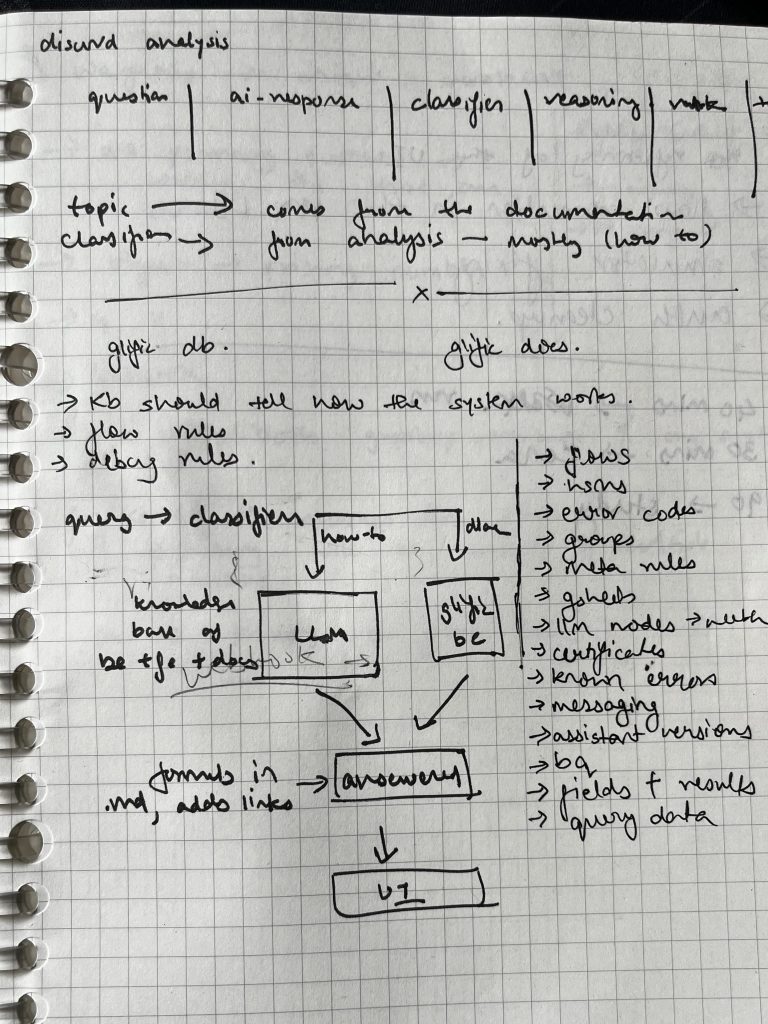
Planning and notes for AskGlific
And honestly, I think that has made me a better engineer. With AI handling more of the mechanical work, I get to spend my energy on the harder, more interesting questions: the why behind what I’m building, the shape of the solution, and whether it will still make sense six months from now. I’m thinking about the big picture, and about the long term. And that, it turns out, is its own kind of joy.