
This year I completed four years at Tech4Dev. That’s the longest I’ve stayed anywhere.
I don’t say that as a small thing. Four years is enough time to really understand an organisation, its people, its problems, its potential. And looking back, I think I’ve grown more in these four years than in any other period of my career. Not just in skills, but in how I think, how I work, and what I believe I’m actually here to do.
I’ve always been someone who can’t just do the job in front of me. I want to understand what’s happening across the team, what others are working on, where they’re stuck, whether there’s something I can do to help. I think differently, and I’ve learned to trust that. My instinct is always to push further, learn more, and share whatever I find along the way.
But this year tested all of that.
When everything hits at once
March’26 was one of the hardest periods I’ve had in a long time. It wasn’t just one thing. Work pressure, family pressure, everything seemed to pile on at the same time. I was carrying too much in too many directions at once, and the anxiety that came with it was overwhelming. At some point my body just said no. Back pain, neck pain, the kind of physical exhaustion that makes it impossible to sit at a desk. I had pushed so hard, on so many fronts, that I hit a wall I couldn’t think my way through.
I took some rest. Did physiotherapy. Tried to stop thinking so much.
But here’s the thing about that kind of period. Even when you come out the other side, it leaves a mark. Stress still triggers the tension in my neck. I’m still learning to catch myself before I spiral. It’s a work in progress and still recovering though. Believe me its very hard to work in this state and still I kept working which was not good.
What changed, though, was what I decided to do with all of it.
Signal and noise
Somewhere in that difficult stretch, I started asking a different question. Not “why isn’t this working?” but “what actually matters here?”
The answer I kept coming back to was simple: signal versus noise. The signal is what you genuinely want to achieve. The noise is everything else. The anxiety about other people’s opinions, the pressure to prove yourself, the endless second-guessing. I had been drowning in noise for months without realising it.
So I made a deliberate decision to stop. I picked the things that actually mattered, going deep on AI, helping my team think differently, shipping experiments fast, and I let the rest go. I stopped measuring my progress by whether people replied to my messages or whether I was visibly impressing anyone. I just kept moving toward the signal.
It’s harder than it sounds. But once it clicks, it frees up an enormous amount of energy.
Learning alone isn’t enough
Once I committed to going deep on AI, I went all in. Over a few months I worked through dozens of videos, blogs, and courses on AI agents, prompt engineering, context engineering, and how to build systems that are actually reliable. It was a lot to absorb.
But knowledge sitting in one person’s head is just a bottleneck waiting to happen.
So I started sharing. Not through formal training sessions or long documents, but in small, concrete ways. I’d build something that made my work faster, then walk over to a colleague and say: “Look at this. I think you could use something like this too.” I started threads in our team channels with things I was reading. I explained not just what I was building but why. What problem it solved, what it made possible.
The goal wasn’t to teach. It was to make people curious.
How I pushed the team forward
The way I think about engineering work is simple: plan, build, validate. You don’t spend weeks thinking before you start, and you don’t ship something without checking if it actually worked. You move in short cycles. Form a hypothesis, try it, learn from what happens, repeat.
I started applying the same structure to how I pushed ideas across the team.
I created threads in our Fellowship channel around topics I was exploring and learning. Things I thought were worth discussing. I kept putting things out there one at a time.

Then I opened a channel called “Think Out Loud” specifically for the Dalgo team. A space where anyone could drop a half-formed idea, share something they’d read, or raise a problem without needing to have the answer first. No polish required. Just thinking in the open.

People started replying. Not just reacting, but contributing. Ideas I hadn’t considered. Pushbacks that made me think harder. Fresh angles from people who’d been sitting on good thoughts and finally had somewhere to put them.
This is something I’ve seen work well between me, Ishan, and Himanshu for a while. We regularly share what we’re reading, challenge each other’s thinking, build on each other’s ideas. It’s not a formal process. It’s just a habit of keeping each other sharp. And it’s one of the most productive dynamics I’ve experienced at work.
Tech4Dev has genuinely good people. But I think we can do a lot more. There’s so much room to experiment, to try new things, to push our thinking further. All it takes is a nudge. A small push to think about something new, discuss it openly, and see where it goes. That’s what I’ve been trying to create, and I think we’re just getting started.
Bangalore Sprint
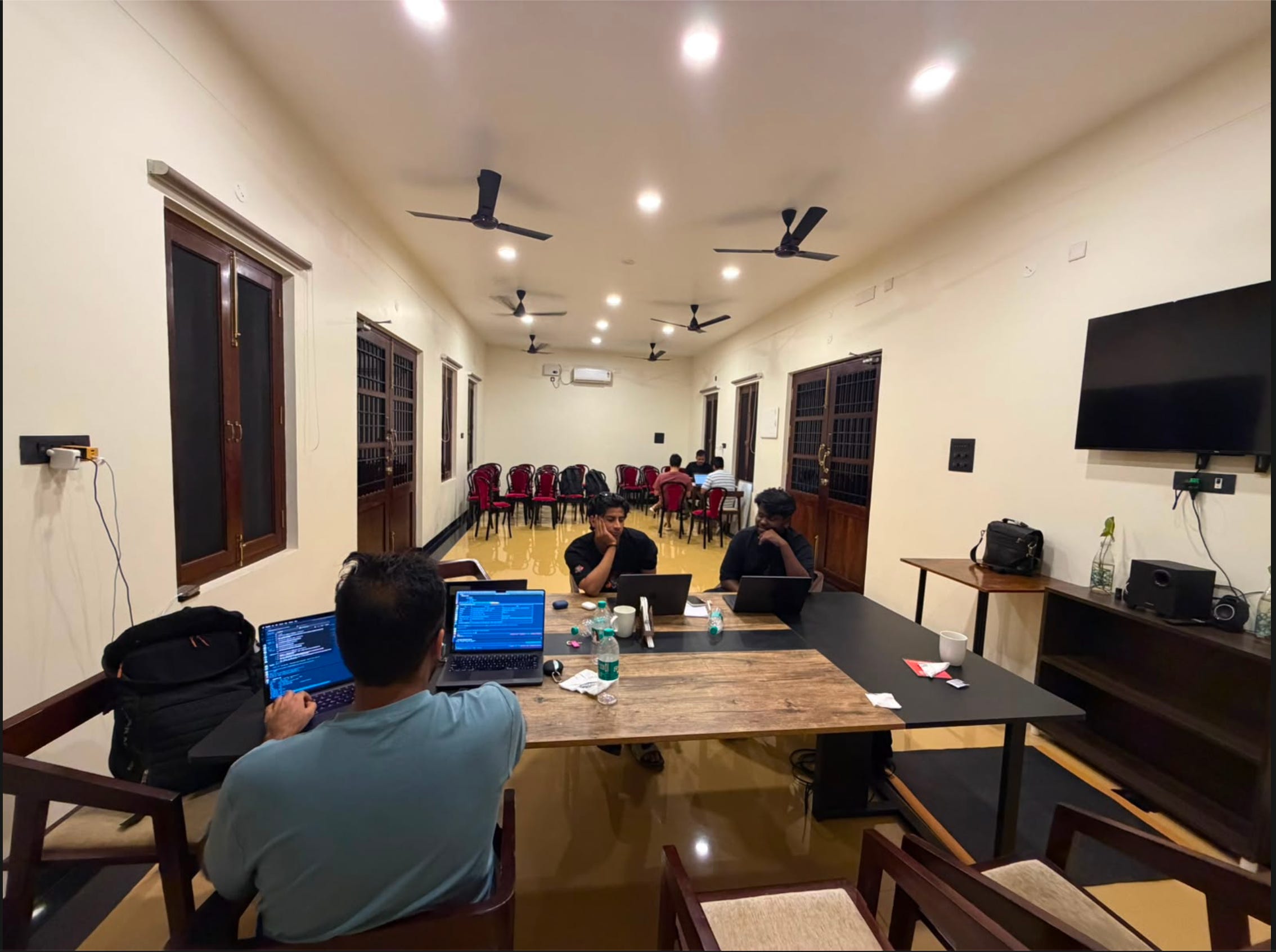
Threads and channels can only go so far. Sometimes you just need to be in the same room. I recently met with the Glific and Kaapi teams and it was one of the more productive sessions I’ve had in a while. Three things came out of that meeting directly:
- Sentry Autofix. I walked Akansha through what’s possible with Sentry Autofix, a tool that uses AI to automatically suggest fixes for errors in your code. A thread I had created earlier suddenly came to life and the team is now actively testing it.
- MCP workflows. We quickly set up an MCP workflow together. Akansha picked it up fast, built something with it, and saw it working in action. That kind of speed is exactly what I want to see more of.
- Improving how we work with AI. I had a long conversation with Akki about how the team can get better at using AI day to day. He has already set up his own AI workflow and is improving it bit by bit. I think others on the team need to dive deeper and do the same.
This is what nudging looks like in practice. Not a presentation. Just sitting together, showing what’s possible, and letting people run with it.
What’s next
I’m not done. If anything, I feel like I’m just getting started.
There are three things I want to go deeper into right now:
- Taking MCP to production. Making it reliable, secure, and ready for real use, not just experiments.
- Context engineering. How you design the information an AI agent works with so it makes better decisions. Most people haven’t paid enough attention to this yet, and I think it matters a lot.
- Building AI workflows for NGOs. Finding the real use cases, building them end to end, and sharing what I learn along the way.
But honestly, what excites me most is what’s coming next across Tech4Dev as a whole. I think we’re just scratching the surface of what’s possible with AI. The next few months are going to be interesting. More experiments, more ideas surfacing, more people building things I haven’t thought of yet. I genuinely can’t wait to see what the team comes up with