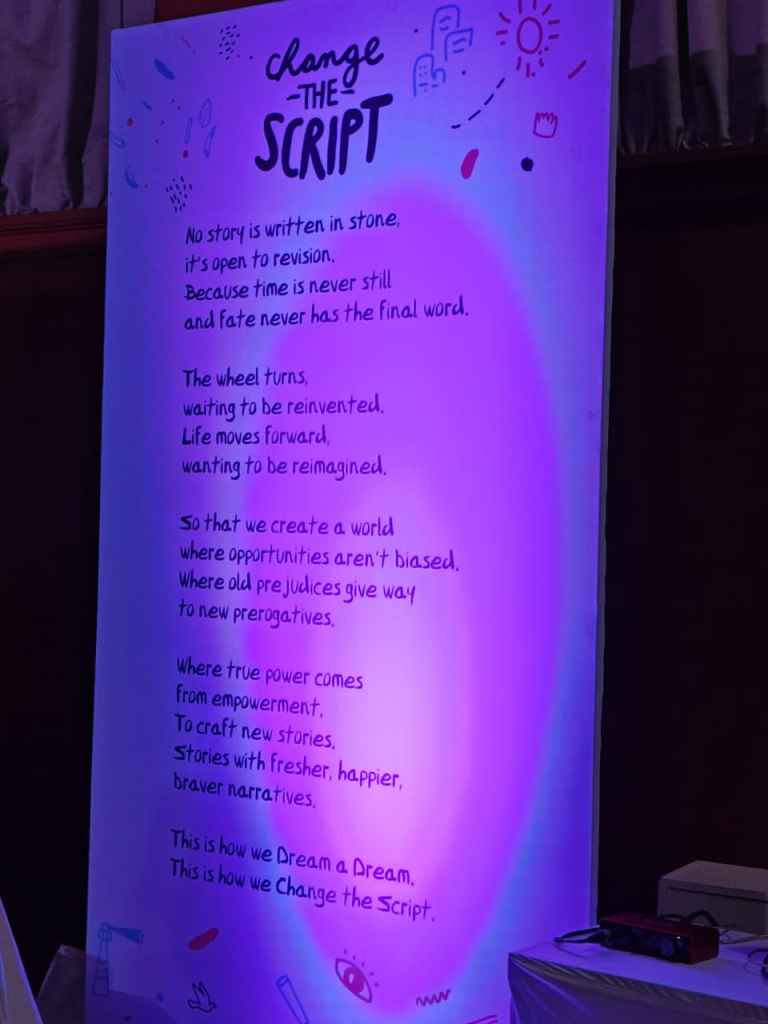
The questions that I raise in this blog post are questions I am trying to answer for myself and share what I took away from Change the Script 2026, organised by Dream a dream.
I grew up in Mumbai. I remember passing by the Andheri railway station bridge on my way to college as a student. I would see people who didn’t have homes to stay in, children who didn’t have enough food to eat. Something never quite sat right, didn’t feel right. I used to think I would study hard, reach a position of power, and when I felt I was able to, I would do something for people who didn’t have their basic needs met.
I joined Unilever and, during training, went to Dharavi on a sales beat. The next day, I went to Bandra. Saw and experienced two completely different worlds, just a few kilometres apart. That same gut-wrenching feeling came back.
One image that has remained with me is that of a small child in Dharavi who wanted a sachet of Horlicks. I don’t think that the child even knew that it was a ₹5 coin, but he was sent back without the sachet he was sent to get. The smallest pack available cost more. I don’t know if he had milk that day. I don’t know if he went to school. As I spent the day in the lanes of Dharavi, I heard more stories of pain, hurt and deprivation. My heart just couldn’t look at these stories through the lens of – how do we sell more to this demographic – that just felt inhuman….so I took the opportunity secretly to speak to people, to try to get a glimpse of what their lives look like.
I continued with my training and eventually got to lead the Personal Products division.
Fair & Lovely was one of the products. If you remember the advertisements, they often centered around a young woman lacking confidence because of her skin colour, and how using Fair & Lovely would give her confidence.
I remember looking at the sales numbers on trackers sent to us each day. I was the area sale manager so I was supposed to increase sales of personal products in some districts of Uttar Pradesh. My parents come from Uttar Pradesh. They studied in government schools there. And it feels strange to look back now, we would discuss which brand name would attract attention, which insecurity we should emphasise on, and what messaging would drive sales. Something kept nagging me, nothing felt like I belonged there, my notes in meetings would be – why am I here, what am I doing here…I grew silent by the day…stopped participating in meetings. There was a lot of chaos in my mind since – wasn’t this supposed to be my dream? A bigger confusion was – If not this, I have no clue what. I used to feel weirdly suffocated in open spaces. The hollowness would gnaw at my conscience slowly every day.
Change the Script felt like that feeling multiplied many times over.
It brought back those memories and added many more stories of how some of us have taken so much from our shared resources without stopping to think about what is left for others.
A simple metaphor comes to my mind as I type this.
Imagine a pot with 10 litres of water and 10 people standing around it. Each person needs one litre. But they are standing at different distances from the pot. The person closest takes five litres. The second takes two. The third takes two.
The first three people are happy and fulfilled.
What happens to everyone else?
What if, we now imagine a different reality? What if these 10 people recognise each other’s needs? They acknowledge that they are different people with different circumstances and needs. They wait, listen, see, hear, discuss and share.
Everyone gets what they need.
And the sum total of happiness and contentment is much higher than in the first case.
And just to add more colour to this picture, the water isn’t at all finer things in life. The water means really water for some people, food for some, basic needs like healthcare, safety, a chance to learn and grow, a chance to show up as their complete selves and all the things that allow someone to live with dignity.
What does it take for us to realise this? Or what did it take me to realize this?
What does it take for us to recognise our own privileges? Why does it sometimes take hearing stories of deprivation from others for us to realise how much we already have? Why does the burden of making us human fall too on those who are already deprived?
किसी और के कंधों पर खड़े होकर ही हमें ऊँचा होने का एहसास क्यों होता है?
किसी को पीछे छोड़कर ही हमें आगे बढ़ने का एहसास क्यों होता है?
किसी को नीचा दिखाकर ही हमें ऊँचा होने का एहसास क्यों होता है?
किसी और की कीमत पर कुछ हासिल कर लेने पर ही हमें उपलब्धि का एहसास क्यों होता है?
Why is our sense of self, relative to others or in comparison with others? Why do we use words like upper and lower for people?
What if we think collectively where we are instead of individually? How would the world look like, then? How would we behave differently then?
It is our lack of awareness and understanding, it is our failure, if we don’t know what others around us are going through. And perhaps it is a failure of all of us if any one person is deprived of their basic needs. It is a responsibility to understand our community and their needs.
And something beautiful happens when we do this. We begin to see the interconnectedness, the shared humanity between us. We feel the pain, joy and laughter of others. When our eyes fill up while listening to someone’s pain, perhaps that is when we realise how deeply connected we all are.
We grow with our community, not by ourselves.
I got the chance to be in a room full of so many diverse, different and beautiful people. I have taken so much from my community, and from this community in particular.
I got to speak to inspiring people and draw inspiration from them. So many conversations I could resonate with. So many thoughts that gave me goosebumps. So many stories that filled up my eyes.
I realised what privilege means.
Hearing stories shared, different emotions rose within of sadness, restlessness, anger, helplessness even. I realised I will probably never be able to count all the privileges I have. And that giving back to the community is not something to do as an afterthought. This feels especially important for people designing systems for others.
B mentioned that although we teach our kids that cow gives us milk, that is not true. The truth is that we snatch milk away from the cow. Isn’t that true for some many things. The Earth has resources as gifts but we seem to be in a race to collect as much as possible as fast as possible.
I spoke to A, who shared something that stayed with me. Imagine a teacher who focuses on one “smart” child and keeps telling them: study hard, achieve things, get a big job, earn a good salary and build a good life. The child grows up believing that everything they have the big job, the salary, the exposure, the opportunities is theirs because they worked hard for it. And therefore, it is theirs to keep.
Isn’t that a form of hoarding?
Not just hoarding money or physical resources, but hoarding the softer things that shape our lives exposure, confidence, knowledge, networks, opportunities. A wanted to change that narrative. To motivate children to learn and grow, but also to understand that what they gain can eventually be used to contribute to their communities. That conversation gave me goosebumps. How much can a small narrative in our minds shape the way we grow up?
What story do we tell children about why they succeed? “I worked hard and earned this” versus “I was supported by a community, and now I have a responsibility to contribute to it.”
And perhaps that brings me to the question: What are the systems we design, and who are we designing them for?
It feels so important to ask this question before we design a school, a technology platform, a policy, a programme, a workplace, a community. Are we designing for people, or are we taking the time to understand and design with them?
As a student, I thought I needed to reach a position of power to help, the event made me realise that awareness, relationships, listening and everyday choices are already forms of responsibility.
This event felt like I could see humanity and interconnectedness, and feel it up close. I want to preserve the stories in my mind, the feeling in my heart, and channel all this energy into reaching out more to my community intentionally trying to understand, read, listen and speak to others, design better systems at work. And, most importantly, thinking about how I conduct myself internally, at home, at work, with partners and with my community.
I couldn’t be more grateful for the opportunity to experience Change the Script. Thank you, Dream a Dream, for putting together such a beautiful immersion.