Over the last few months, we’ve been working closely with a few NGOs, helping them assess student work at scale using AI.
A few of them: PSL (Problem Solvers Lab), Inqui-Lab Foundation and TAP (The Apprentice Project) build skills like problem-solving, creativity and collaboration in students from government schools and low-income families. The Deodar Prize looks for new voices in Indian fiction, and writers submit unpublished English short stories.
All of them share one goal: assess and grade the submitted work and give the feedback to students that helps them to grow.
Why grading at scale is hard
NGOs like Inquilab and TAP assess lakhs of students submissions. They runs innovation programes where students spot problems around them and pitch ideas to solve them. Grading that many by hand just doesn’t work. First, you need a lot of teachers. Second, even with enough teachers, scores aren’t consistent.
Two teachers can give the same work different scores: one may be strict, the other lenient. Even the same teacher may score differently depending on their workload or the kind of day they’re having. And for some programes, grading a single idea takes 20-30 minutes.
Expert teachers are also hard to find. So AI clearly helps, but it’s only as good as the rubric/instructions we give it.
Unclear rubric, different scores
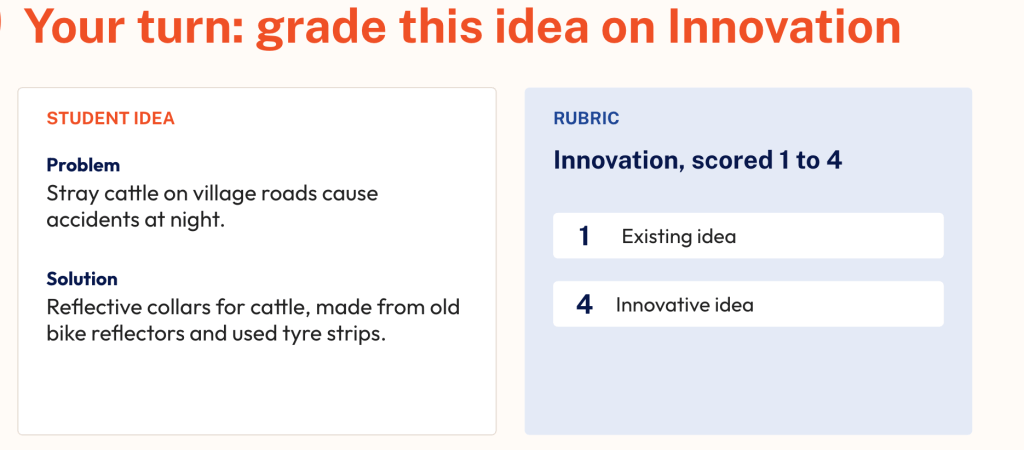
Here’s a simple example. In a webinar, we asked everyone to grade the same idea on innovation.
Responses
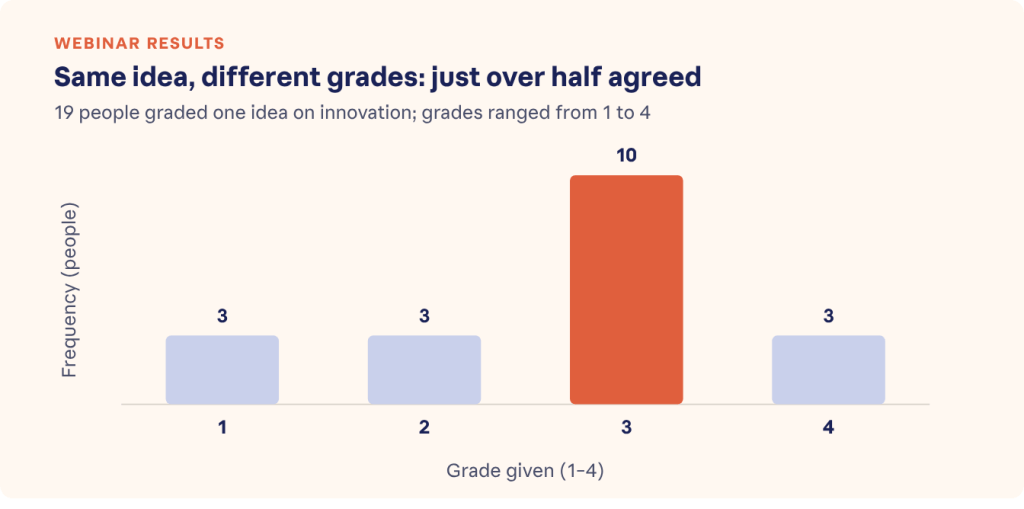
The scores varied a lot. When a rubric isn’t clear, people fill the gaps with their own judgement/context.
AI makes the same mistake
AI looked like the answer. It works at scale and never gets tired. But once we started using it, we noticed two problems. First, there was a gap between AI scores and the scores human reviewers expected. And not just that: when we asked AI to grade the same submission across different runs, its own scores varied.
The problem wasn’t mainly the model. It was the rubric. When a rubric is vague, AI does exactly what humans do: it fills the gaps. And each run fills them a little differently.
Think of it like cooking. Ask five cooks to “add salt” and you’ll get five different dishes. Ask them to “add one teaspoon of salt” and the dishes come out much closer.
From manual fixes to a rubric refinement agent
At first, we fixed this by hand. Whenever human and AI scores didn’t match, our NGO partner team picked the submissions with the biggest gaps, looked for patterns, and read the human graders’ notes to understand their reasoning. Then they updated the rubric.
It worked, but it was slow and tedious. So we asked ourselves: can AI do this part too? That’s how we built the rubric refinement agent.
Here’s how it works:
Architecture: The agent takes two inputs: your current rubric and a golden set of submissions already scored by your reviewers. Inside, three roles work in a loop: the Scorer grades every submission using the rubric, the Judge compares those scores with the golden set and explains what’s off and why, and the Generator rewrites the rubric to fix it. The best version comes out as the final refined rubric, one that scores like your reviewers
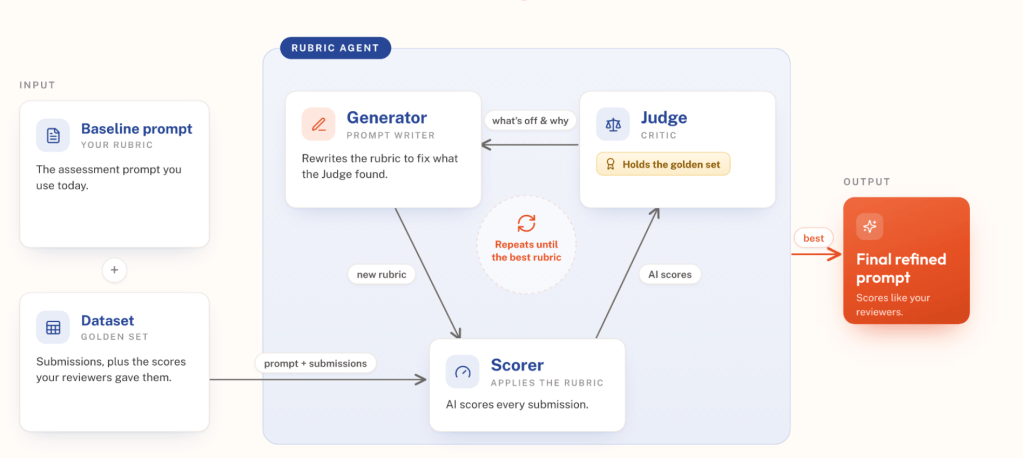
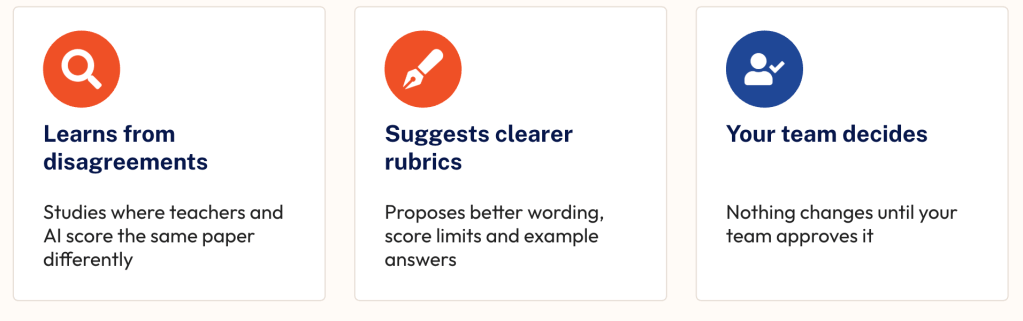
The loop stops after a set number of runs, or once the Gap/MAE (Mean Absolute Error) between AI and human scores drops below a set threshold. The final suggested rubric/prompt changes can be reviewed and approved by the domain expert.
Results so far are mixed. In several cases, the agent significantly reduced the Gap/MAE between AI and human scores or raised the exact-match rate. In others, it made little difference, or the rubric changes it suggested weren’t ones NGO accepted.
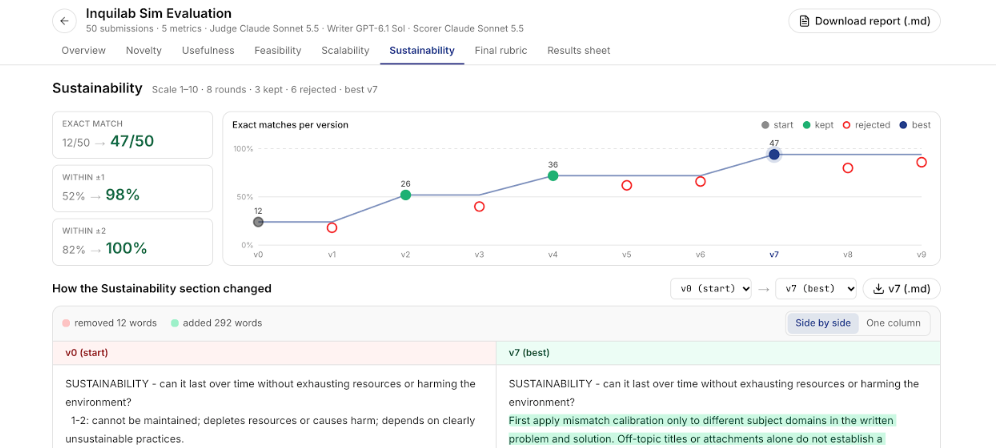
Here’s one example. For the Sustainability criterion, the refined rubric brought AI scores much closer to the human scores.
Other observations
- A reliable golden dataset is hard to build. How do you know the human scores are right and consistent in the golden truth samples?
What works: have 2-3 teachers score the same submissions separately and explain their scores. Where they differ, tighten the rubric and repeat until they agree. Only then build the golden dataset and run AI on it - Check the system prompt too. In two of our use cases, initial rubric changes made scores worse. The rubric asked for strict scoring, but the system prompt had instructions for the model to be generous, so the two conflicted. Refining the rubric alone didn’t help; both needed fixing
- AI tends to be generous. It leans towards higher scores. The gap was larger for low-scoring submissions and smaller for high-scoring ones. What helped: ask it to start from the lowest score and move up only when it finds evidence in the work (burden of proof)
- Blurry images still cause trouble. When a photo of the work isn’t clear, LLMs/Vision models sometimes hallucinate. So still work to be done here
The takeaway: When AI scores look inconsistent, check the rubric before you blame the model. A clear rubric helps AI scores to be consistent across different runs and also align with the Humans.