Our Vision: A world with a robust technology ecosystem powering the social sector
Our Mission: Build and support the ecosystem of software, data, design companies, nonprofit partners, and foundations working towards creating social impact globally

Project Tech4Dev Team – 2025 – Wow, we are such a big team now!
Summary
It’s been quite a busy quarter for the entire team at Project Tech4Dev. A few of us have been on the road for the past 4 weeks, attending events in Bangalore, Mumbai, New York, and San Francisco. From developer sprints to team meetings, from AI to tech and data, from NGOs to funders and ecosystem partners, from small group dinners to large events across multiple days, all this and more in what was a super busy month and quarter. It has been amazing to watch the team in action, to see where we are, what we are doing well, and what we could improve on. Where are we headed, and which fork in the road should we take? Overall, AI is the dominant theme in the conversation both amongst our partners, funders, and the events we participate in.
The big takeaway from the last quarter is the remarkable sense of ownership each of our teams has demonstrated. We’ve successfully organised multiple events across different cities, involving various parts of the ecosystem. In the second week of September alone, we had four events running simultaneously across Glific, Dalgo, AI and the Fractional CxO teams in different cities. This initiative and leadership within our product teams are a testament to our goals of building a strong ecosystem.
Another recurring theme across many of the events was the conversation about AI and its potential in the social sector: the cultural context, the bias, the support for low-resource languages, and the costs when it scales. We’ve decided to double down on our AI efforts because we believe in its potential for social good at scale. We’re encouraging our NGOs to experiment with AI both operationally and in their programs. The support we’ve received from funders for both the mentors for the AI Cohort and the grant for NGOs’ capacity building is a testament to the confidence in our AI initiatives. We are hiring aggressively for the team, and in a short time, the AI team has grown to 7 people. We will add a few more experienced team members before the end of the year.
Highlights
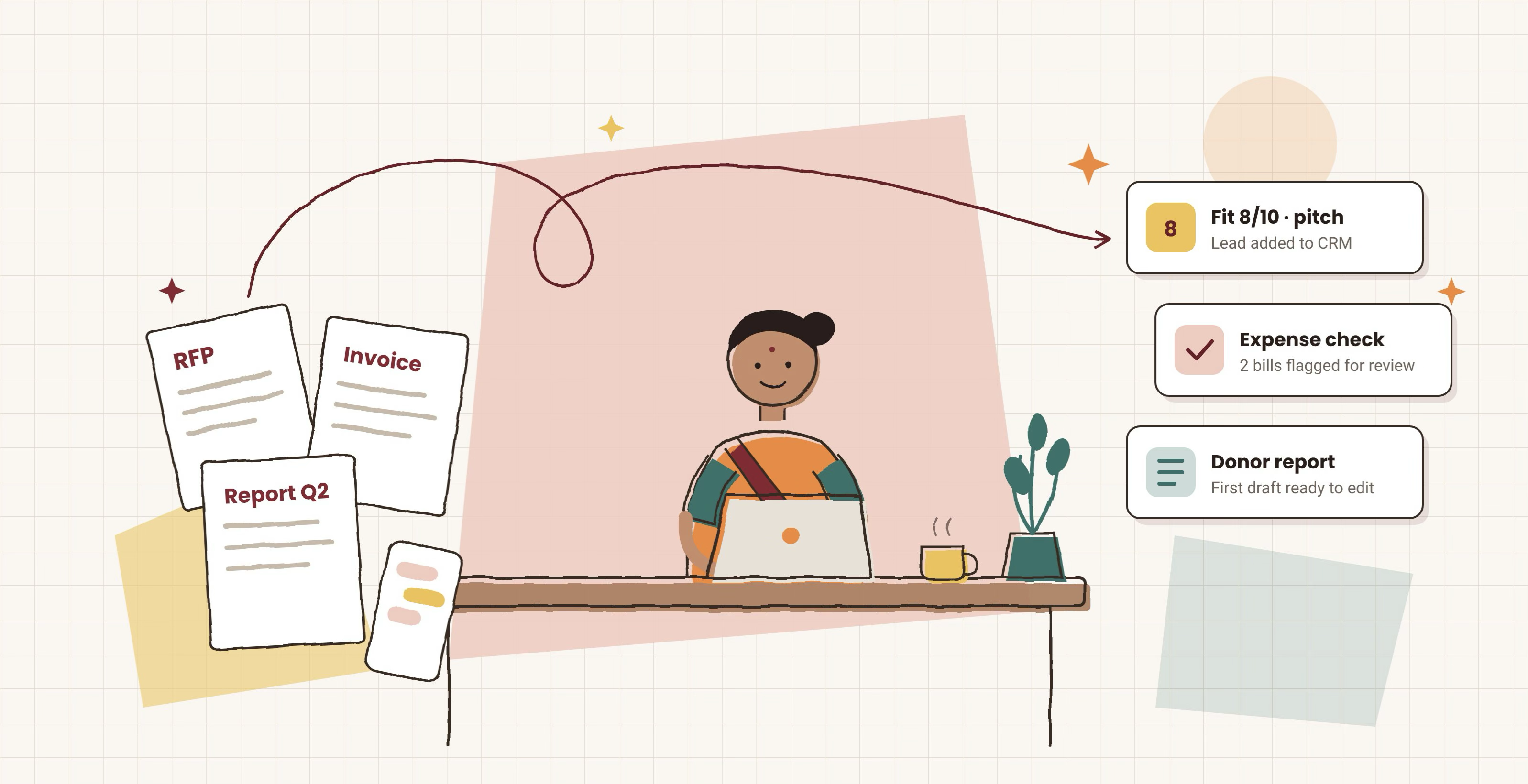
- Without a doubt, the highlight of the last quarter was the number of events we held across India. We piloted a developer pre-sprint before the NGO gathering to give our developers a chance to learn from each other. The Glific and Dalgo teams also held their NGO sprints, with 10+ NGOs participating in each. This report has a graphic essay on how we run our sprints and cohorts. These events showcase our direction and provide a platform for learning and collaboration.
- We re-initiated the convening for senior leadership in the sector, Tech4Impact, with a CEO/CTO meet in Mumbai. The goal was to bring senior leaders together for honest conversations — about wins, struggles, and failures — and to build genuine connections. Conferences often feel broad, but we wanted every participant to walk away with one clear takeaway: knowing exactly who they can call when they’re stuck. Because when those connections deepen, the ecosystem becomes stronger, more resilient, and better equipped to create impact.
- Peer learning, knowledge sharing, and structured mentorship are ways we can work with multiple NGOs, and we continue to do so with the Data Catalyst Program and the AI Cohort. The AI Cohort is an interesting experiment for us, since we are helping the NGOs significantly, both through mentorship (4-8 hours per week) and by funding them to hire a resource to help them move faster and experiment with AI. For the first time, we are also giving NGO teams monthly evaluations to ensure we are on track to meet their objectives.
- Lobo attended the Fund.ai meeting in San Francisco, where a large number of US philanthropies were in attendance. It was an enlightening conference, primarily since it gave us a better understanding of where AI was, especially from a funder perspective. Based on this and other conversations, the work we are doing in AI, along with the Agency Fund, is definitely at the forefront of learning and experiments in the space. While most foundations were interested in AI, their capacity and understanding of it are very basic. We plan to take some of the learnings from this event and organise events across India for funders to learn and see what we have done with AI in the sector.
- Throughout this quarter, our team has been actively participating in various NGO events. Ishan and Abhishek attended the Change the Script conference organised by Dream a Dream; Siddhant spent time with Make a Difference; and Akhilesh and some developers went to ATREE and Reap Benefit. Fawas and Sangeeta attended KEF. Radhika spent a few days in conversations with NGOs in Bangalore, and Lobo spent time with Educate Girls, Avanti Fellows, and Medha.
- Our funding pipeline continues to grow and strengthen. We got a grant from Laidir Foundation to support our AI Cohort and related work on our AI Platform (Kaapi). We’ve gotten strong traction with funders for our next 3-year cycle, with most of our major funders renewing their grants at the same or higher levels. Also, seeing an increase in funders who want to support their NGOs directly for the work they do alongside us, which helps us advance our ecosystem vision of strengthening NGOs’ capacity.
- Articles published by Rohit (who moved on from Dalgo) and Deepak, our comms lead, on trust, ownership, and caring within Tech4Dev by Amit, in our finance team, really reinforced that what we are trying to do at Tech4Dev is working. Our recent McKinsey Organisational Health Survey echoed this, with an overall health score of 92, placing us in the top decile globally, and high marks in leadership, motivation, and inclusion — qualities that truly reflect who we are as a team.
Platform Highlights
- Glific has been experimenting with different types of cohorts to onboard multiple NGOs at once, along with peer learning and getting something working in 2 days. The events include the Accelerator Cohort, Restart Cohort and Launchpad and have become a significant source of new customers.
- The Fractional CxO group is moving into advisory roles, specifically in Cybersecurity, with a couple of NGOs. We are planning to pilot a full-service product and tech team with a few NGOs for 9-12 months. A second trial of the tech for grassroots NGOs is being launched in Tamil Nadu and Karnataka this quarter.
- The beta version of Dalgo 2.0 has been released and shared with our customers during the September sprint. There was a significant increase in development velocity due to the use of Claude Code – although we are now wary about potential maintainability challenges and need to shift the pendulum a bit away from AI-assisted development over the next quarter.
- The Avni team is experimenting with AI to help jump-start NGOs onto its platform, using an AI co-pilot to design and implement their data-collection processes. The work is part of our AI Cohort, and a version has been released to advanced users.
- The Kaapi (AI Platform) and Sashakt (Assessment Platform) have released v1.0 into the wild. Really excited to see the rollout of Sashakt within the government ecosystem and how we can effectively support and train field workers to use the system. Kaapi will be significantly influenced by working with the 7 NGOs in our AI Cohort.
Misses
- As we grow as an organisation, ensuring that the team is focused on their work and deliverables while also seeing the bigger picture is always challenging. In the past few quarters, we have used the 3-month probation period effectively and have parted ways with a couple of people, especially at the mid- to senior-level.
- As our client base grows and support and operations take longer, our product velocity has slowed a bit. This was a topic of discussion during the last sprint, with significant disagreement on this across the team. We need to do a better job of documenting processes, spend more time planning cross-team collaboration, and ensure clear expectations and deliverables from everyone.
- While multi-lingual voice integration is critical from a conversational perspective, the current solutions are not up to the mark. We need to determine if there are good alternatives across different models, especially for low-resource languages.
- This used to be at the top of our misses list for a long time; the good news is it has come down the list. It still takes a lot of time and effort to convert high-intention customers—even those who have attended a bootcamp. This is something we really need to unlock if Dalgo and Avni’s customer numbers are to scale rapidly.
- For Avni, with uncertainty around future grants and in a bid to reduce expenses and improve efficiency, we continued to shrink the team, and bizdev transitions reduced capacity, stretched bandwidth, dampened outreach, and lengthened sales cycles. Our AI experiments with Avni are designed to determine whether we can deliver better services at lower cost to our users, thereby increasing demand.
What’s Next
We had this paragraph in the previous report, but it gives the new reader a glimpse of where we are going. As we look ahead, we are excited to share that our Tech4Dev 3.0 strategy for 2026–2029 is now ready. The strategy is built on six years of working with 200+ NGOs across India and Africa. It focuses on scaling our existing platforms, developing new platforms, deploying fractional tech and product teams, supporting grassroots NGOs, and strengthening the ecosystem. Through Tech4Dev Global, we plan to expand our mission beyond the Global Majority by engaging skilled professionals from around the world who are eager to contribute to social impact. We are also partnering with The Agency Fund to drive AI for human development, and with Dasra to strengthen tech and data capacity across the sector.


Financials
If you would like to see our complete financials, email us at info@projecttech4dev.org
| Tech4Dev 2.0 – Summary of the Inflow & Outflow | |||||
|---|---|---|---|---|---|
| (USD’000) | |||||
| RECEIPTS | “Actual(YTD)” | Q1 Act.Jun 25 | Q2 ActSep 25 | Q3 Act.Dec 25 | Q4 Act.March 26 |
| B/f Donor bal | $5,961 | $5,961 | $5,950 | ||
| Grant | $860 | $348 | $512 | ||
| Earned Revenue | $349 | $160 | $189 | ||
| Total | $7,170 | $6,469 | $6,651 | ||
| EXPENDITURE | “Actual(YTD)” | Q1 Act.Jun 25 | Q2 ActSep 25 | Q3 Act.Dec 25 | Q4 Act.March 26 |
| Program Salaries | $851 | $415 | $436 | ||
| Program Cost | $251 | $105 | $146 | ||
| Total | $1,102 | $520 | $583 | ||
| C/f Donor bal | $6,068 | $5,950 | $6,068 | ||
| Tech4Dev 2.0 – Summary of the Inflow & Outflow | |||||
| (in INR Crore) | |||||
| RECEIPTS | “Actual(YTD)” | Q1 Act.Jun 25 | Q2 ActSep 25 | Q3 Act.Dec 25 | Q4 Act.March 26 |
| B/f Donor bal | 50.07 | 50.07 | 49.98 | ||
| Grant | 7.22 | 2.92 | 4.30 | ||
| Earned Revenue | 2.93 | 1.35 | 1.58 | ||
| Total | 60.23 | 54.34 | 55.86 | ||
| EXPENDITURE | “Actual(YTD)” | Q1 Act.Jun 25 | Q2 ActSep 25 | Q3 Act.Dec 25 | Q4 Act.March 26 |
| Program Salaries | 7.15 | 3.49 | 3.67 | ||
| Program Cost | 2.11 | 0.88 | 1.23 | ||
| Total | 9.26 | 4.36 | 4.89 | ||
| C/f Donor bal | 50.97 | 49.98 | 50.97 | ||
Key Platform Metrics
Introducing a new section that we will expand on in future reports. Let us know the type of information and/or visuals you would like us to report on.
| Platform | Total accounts | Active accounts | Accounts onboarded in Q2 | Q Revenue$(000)s | Q Expenses$(000)s | YTD Revenue $(000)s | YTD Expenses$(000)s |
| Glific | 206 | 108 | 10 | 43 | 80 | 83 | 163 |
| Dalgo | 23 | 21 | 4 | 28 | 85 | 53 | 156 |
| fCxO | 31 | 13 | 3 | 61 | 82 | 117 | 166 |
| Avni | 69 | 38 | 5 | 61 | 107 | 113 | 367 |
At a Glance: Platform Metrics
More Details
Highlighting some of the blog posts written by team members from last quarter:
- Inside Glific: Story of the Team’s Evolution
- Shining Hope from Within: SHOFCO’s Empowerment Story with Dalgo
- Two Weeks, Four Sprints, Endless Stories
- From Engagement to Impact: Reflections on the Glific Sprint
- Reflections from Glific Sprint, Part 2. The Prototype Track
- AI Cohort Program | By Avanti Fellows
- Reflections from the Dalgo Sprint: Connect, Learn, Advance
We’d love to hear from you, whether it’s feedback, ideas, or questions. Drop us a line via email, and we will get back to you. If you want to know more about our work, visit our website.
If you want to stay in the loop, follow us on LinkedIn and/or join our WhatsApp channel for regular updates